Phyllis Schlafly and the Modern Mormon Political Image

(Yes, I know, Phyllis Schafly wasn’t Mormon. But bear with me.)

News leaked out yesterday that Schlafly, one of the most prominent figures of America’s Religious Right, passed away at the age of 92. There will be plenty of excellent historians who will explain her significance to America’s political history. (That is, if there are any American political historians left. Sigh.) When I taught Religion and American Politics we spent an entire week dissecting Schlafly and the religious opposition to the ERA; it was one of the most vibrant discussions of the semester. I am looking forward to covering her in my American religious history class later this fall.

But I just wanted to say a few words about Schlafly’s importance to the history of modern Mormon conservatism. It is well known that a number of LDS leaders were both sympathetic to and involved with the rise of the Religious Right. Most notably, Ezra Taft Benson was a prominent John Bircher, and he helped articulate a Mormon political theology that was steeped in both the Culture Wars and anti-communism. Mormon Utah mostly followed the political and demographic trends, with important distinctions, with the American South during the second half of the twentieth century. But in general, the Mormon political voice remained predominantly elite and male.[1]

What changed this was the Church’s opposition to the Equal Rights Amendment in the late 1970s and early 1980s. The ERA, which seemed destined to passage during the early 1970s, ended up losing in the wake of an immense conservative backlash that was driven by prominent members of the Religious Right, especially Schlafly who was the most vocal spokeswoman. Mormon leaders spoke out against the amendment as well, and volunteers from local congregations were bused out to conventions and rallies to assure its demise. While modern historians and liberal Mormons alike typically look to this moment as a turning point toward Mormon conservative mobilization, it should be noted that the anti-ERA protest provided a venue for LDS women to participate in the political arena—something that had otherwise been forfeited in an age when the Church’s renewed patriarchal structure relegated them to the domestic sphere. In a sense, Schlafly provided a model through which Mormon women could engage—and influence!—the partisan world while retaining their conservative, domestic credentials. It’s one of the great ironies that Schlafly and the anti-ERA movement embodied the very type of gendered expansion their actions sought to stifle.[2]

Even more, Phyllis Schlafly and the anti-ERA proponents provided the discourse for Mormons to translate their conservative beliefs into an efficient political vehicle that was effective in the modern political age. The same lessons learned during those late-1970s battles—namely, the identification of a “moral issue” theoretically outside the realm of a partisan divide—provided the foundation for later political battles, most notably those over same-sex marriage starting in the 1990s and through Obergefell last year. The local mobilization, organization based at ward levels while following instructions from higher up, led to a number of victories at the voting booth. In that way, Schlafly’s fingerprints were also over Proposition-8 in 2008. And though she is now gone, her shadow will likely still be seen for quite some time.[3]

_____________________

[1] See Gregory A. Prince, “The Red Peril, the Candy Maker, and the Apostle: David O. McKay’s Confrontation with Communism,” Dialogue: A Journal of Mormon Thought 37, no. 2 (Summer 2004): 37-94; Patrick Q. Mason, “Ezra Taft Benson and Modern (Book of) Mormon Conservatism,” in Patrick Mason and John Turner, eds., Out of Obscurity: Mormonism Since 1945 (Oxford UP, 2016): 63-80. For the general transformation of the period, see David E. Campbell, John C. Green, and J. Quin Monson, Seeking the Promised Land: Mormonism and American Politics (Cambridge University Press, 2014).

[2] The general history of Mormonism’s opposition to the ERA is Martha Bradley-Evans, Pedestals and Podiums: Utah Women, Religious Authority, and Equal Rights (Signature Books, 2005). For the anti-ERA movement given Mormon women a political voice, see Neil J. Young, “‘The ERA is a Moral Issue’: The Mormon Church, LDS Women, and the Defeat of the Equal Rights Amendment,” American Quarterly 59, no. 3 (September 2007): 623-644.

[3] For the connection between the ERA and Proposition 8, see Joanna Brooks, “On the ‘Underground’: What the Mormon ‘Yes on 8’ Campaign Reveals About the Future of Mormons in American Political Life,” in Randall Ballmer and Jana Riess, eds., Mormonism and American Politics (Columbia University Press, 2008), 192-209); Neil J. Young, “Mormons and Same-Sex Marriage: From ERA to Prop 8,” in Mason and Turner, eds., Out of Obscurity, 144-169.

The Community of Dialogue

You do a lot of couch surfing as a broke college student. As I was traveling to conferences and archives I relied on the generosity of friends as well as friends-of-friends. I also tried to tap into the vast Mormon network. All to save a buck. I met a lot of great people this way, but it’s always an anxiety-ridden process because you know you are relying on the good will of strangers. There can always be moments of awkwardness.

But I remember once arriving at someone’s house, being welcomed into their living room, seeing an entire run of Dialogue issues displayed prominently on their shelves, and immediately feeling at home. The very presence of those print copies assured me that they were extended family. Even if they hadn’t read all of the articles between each of the covers, mere possession implied an allegiance to a particular sub-culture within the Mormon faith.

Being a Mormon of a certain stripe can be a lonely affair. Especially if you live away from the Mormon belt—where even if there’s a dogmatic and orthodox culture, there’s still a presence of like-minded members—you might be separated from other people anxious to discuss the complexities of being Mormon and modern. This problem has been partly alleviated through the bloggernacle and social media, but before those digital networks Dialogue was the primary mode of progressive Mormon belonging. It would be difficult to overstate the importance of the journal in the Mormon tradition’s transformation over the past half-century. That alone justifies its celebration.

But I also believe Dialogue can be even more important in the digital age, for at least two reasons. First, while information and camaraderie are only a few clicks away, discussions on social media are often fleeting, both in quality and permanence. The very nature of the platform cultivates tempest rhetoric, superficial depth, and limited impact. The reasoned, substantial, and measured approach encapsulated in many of Dialogue‘s finest scholarship is what our community needs. And second, even as Mormon studies flourishes as an academic discipline located primarily outside of Mormon venues, the necessity of directing scholarly rigor toward an eager LDS audience is still prominent. Dialogue provides an arena for that type of work unmatched, for one reason or another, in any other venue.

At the end of this month we, as a Mormon community, are celebrating fifty years of this immensely important vehicle of Mormon thought and the community it has cultivated. I will be participating in the “Spirit of Dialogue” conference taking place during the day of September 30 at UVU, where a lot of other, more talented, voices will also be speaking. That night there will be a formal gala where we will be honoring some of the most important figures in the Mormon faith. It should be a day never to be forgotten.

But just as important as celebrating the last fifty years, we should look forward to the next fifty. Mormons committed to the quest to understand the joys and struggles of modern Mormon should not only subscribe but donate to the cause.

I’m proud to be a Dialogue Mormon.

Framing the American Narrative as a Story of Diversity, Part One: The Survey

This semester I am teaching undergraduate courses in American History to 1876 as well as American Religious History (the entire sweep!). Since both classes are supposed to begin with the “origins” of America, the first few days cover much of the same material. (The third or fourth meetings diverge, of course, as the survey class remains in the early colonial period for a couple more weeks while the religions course vaults into the eighteenth century.) As I prepared curriculum for both classes I was struck with the governing theme I have chosen for each: I wanted my students to recognize that diversity was at the heart of the American experience from the very beginning. I therefore planned activities and discussion topics for the first week that would emphasize this idea and set a tone for the entire semester. This post will focus on what I did in the survey class, and Part II will do the same with my American Religions course.

In the survey course I mostly followed Joe Adelman’s excellent suggestion by asking the question, “when does American history begin?” Students offered a myriad of possibilities: 1776 (the Revolution), 1620 (the Mayflower), 1607 (Jamestown), and 1492 (Columbus) were the most common answers. Some quickly caught on to the ploy and suggested, “what about all the Native Americans who were here a long time before Europeans?” Exactly. I then asked, “what does American history look like if we start the narrative from 10,000BC?” For one, we would need a lot more than 16 weeks to cover all our material. But more importantly, the story would not be framed around triumphant expansion, population booms, and the extension of liberty. Those elements are certainly there for a certain demographic, but they don’t tell the whole story. Also included would be a focus on the loss of land (as tribes were forced to forfeit much of their territory), demographic decimation (the continent was more densely populated in 1491 than 1776), and the loss of freedoms (as indigenous populations were forbidden the rights of citizenship). That’s a more messy, but also more accurate, narrative.

But that was not the only activity meant to add nuance to the students perspective. I also used a series of maps to help students contemplate and discuss how our geographic frameworks both reveal and shape our understanding. First, I show a typical depiction of colonial British America. We note how the emphasis is on the east coast, but that western lands are open and ready to be conquered. The general emphasis, which coincides with later ideas of manifest destiny, is on east-to-west movement. (The Native American perspective, of course, looks west-to-east as they were forced to consolidate in western territories.)

British America 1

John Mitchell (1755) 

But what if we look at colonial America from a Spanish perspective? We talk about how the following map focuses on the natural resources of the continent, as well as how it was oriented on the inland, land-based regions. This mirrored the Spanish approach to colonization, mineral excavation, and mixed labor. The migration is northward from Mexico as they colonized upper regions, like Texas and the Southwest, above their original settlement. If you were to choose an orientation for this perspective, it’d move south-to-north.

Spanish America.png

Nicolas Sanson (1656)

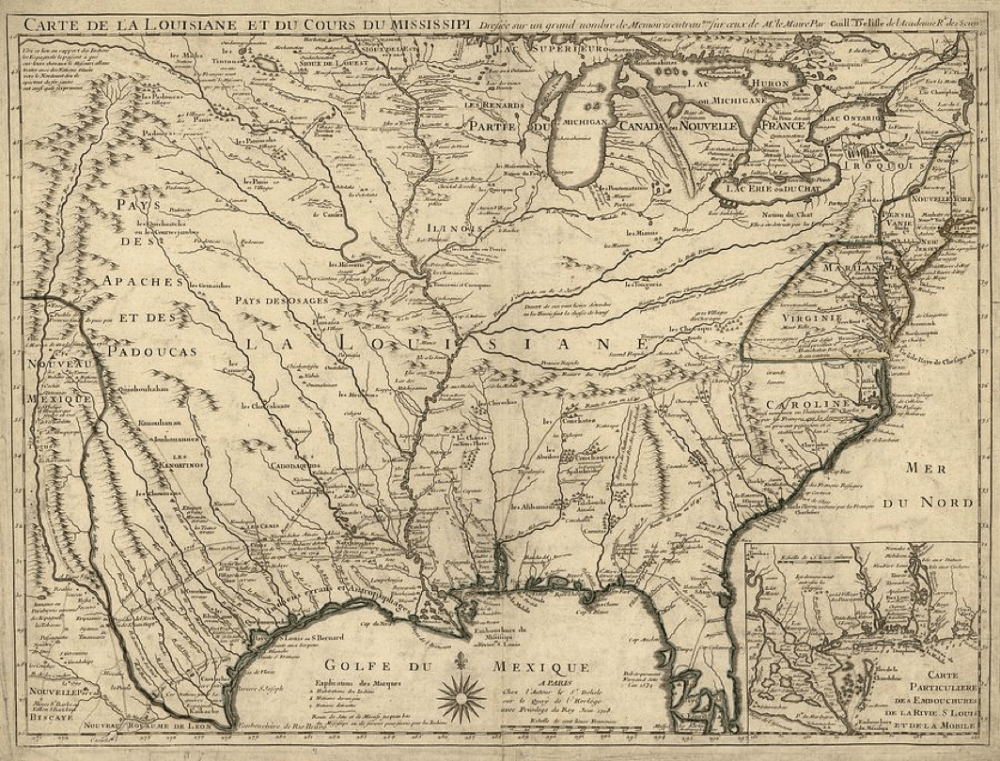
But what if we look at colonial America from a French perspective? France began colonization from the northern end, which is reflected in this early map that looks southward to the rivers and lakes below. The began in Nova Scotia, moved inland to the Great Lakes, then eventuallyfollowed the Mississippi River all the way south to New Orleans. This reflected their emphasis on sea routes and fur trade.

French America 1

Samuel de Champlain (1613)

I also show them this map of French America which clearly demonstrates their focus on the “heartland” of America and their reliance upon the continents many rivers. All of French trade, just like the many North American rivers, flowed downward from present-day-Canada to the Gulf. If I were to characterize this orientation, I’d frame it as north-to-south.

French America 2.png

Guillaume de I’Isle (1718)

More than merely drilling in the point that maps are cultural constructions that reveal much about the assumptions undergirding the colonization project, I want my students to recognize the base principles of the historian’s craft. How we frame our story is a reflection of what we want to get out of it. If we rush toward the British settlements that hugged the eastern seaboard and slowly worked west, then it is clear that we are prioritizing the triumph of an Anglo-American narrative that did not reach the entirety of our current geographic nation until the end of the very end of this semester’s course. That’s quite a narrow framework. Indeed, if I were to follow that story, then the state I am teaching in, Texas, doesn’t really enter the scene until the 1840s, and the residents of the territory pop up out of nowhere. By orienting the story around a myriad of perspectives, populations, and narratives, however, diversity is placed front and center.

As if that weren’t enough, we close the first week of class with a discussion of Lyra Monteiro’s excellent essay, “Race-Conscious Casting and the Erasure of the Black Past in Lin-Manuel Miranda’s Hamilton.” We talk about what an “exclusive past” looks like, and what that type of approach tells us about our own priorities and assumptions. This class, I tell them, will aim to upend that simple story by placing voices and bodies that are usually on the margins on center stage. Only that type of approach can capture a more complete vision of America’s past. And only that emphasis on cultural diversity can give context to our continued problems dealing with pluralism.

Mormon Studies and Edited Collections

Three of the books published this summer that I’m most excited about are edited collections on Mormon topics: Kate Holbrook and Matt Bowman’s Women and Mormonism: Historical and Contemporary Perspectives (University of Utah Press), Patrick Mason’s Directions for Mormon Studies in the Twenty-First Century (University of Utah Press), and Patrick Mason and John Turner’s Out of Obscurity: Mormonism Since 1845 (Oxford University Press). And late last year we also received Randall Ballmer and Jana Riess’s Mormonism and American Politics (Columbia University Press). I’ve read through most of these (Out of Obscurity just arrived yesterday, so give me a couple days), and I’ll probably highlight them each individually in coming weeks. But I wanted to take a minute and note how odd it is (in a good way!) that Mormon studies produces so many edited collections.


For starters, young academics are actively discouraged from putting together edited collections—they take a lot of time and don’t mean much in your tenure portfolio. Further, many university presses are running from edited collections. They are typically seen as the type of academic book that won’t sell well. Even when there’s a special academic conference on a particular topic—which was what led to three of the volumes listed above—the proceedings usually appear in a special issue of an academic journal. For instance, a couple years ago I participated in a conference, hosted by the McNeil Center for Early American Studies, that focused on Benjamin Rush and the early republic. Select papers from that even will appear in Early American Studies next Fall. That is how it typically works, given that it will assure people interested in the field will get a copy since they likely subscribe to the journal. And university presses don’t have to take the risk that an edited volume will just sit in their warehouse shelves collecting dust. But that doesn’t seem to be the case for edited collections on Mormon topics.

So perhaps a large part of what drives the continuation of edited collections in Mormon studies is that Mormonism still sells. Jana Riess pointed out a few years ago how Mormon studies has been a boon for many academic presses, in some cases being their most popular titles. So the same caution that demonstrated in some genres is clearly not present here. Mormons buy books about their faith’s past and tradition, and non-Mormon academics are certainly becoming more interested as well.

But I think there has to be something else. Edited collections have long played an important role in Mormon history. Looking at my shelves I can see a long line of significant edited volumes in the field: Bitton and Beecher’s New Views of Mormon History (University of Utah Press), Bringhurst and Smith’s Black and Mormon (University of Illinois Press), Hanks’s Women and Authority (Signature Books), Bringhurst and Hamer’s Scattering of the Saints (John Whitmer Books), Taysom’s Dimensions of Faith (Signature Books), Bushman’s Mormon Sisters (Utah State University Press), and Beecher and Anderson’s Sisters in Spirit (University of Illinois Press), to just name some most prominent. We’ve done edited collections that focus on past books, like on Arrington’s Great Basin Kingdom, Flanders’s Kingdom on the Mississippi, and Thomas Odea’s The Mormons. Presses like Signature and BYU’s Religious Studies Center have had prolific series of edited collections. Some authors have made a cottage industry of the practice. And given the many edited collections that I know are still in the works, I don’t see this trend stopping any time soon.

What does that say about the field? Probably a lot of things. But I’ll just mention four.

First, it demonstrates the myriad of topics and sources that energize those interested in Mormon history. The MHA community is, much to its strength, a mix of academic and amateur, which often leads to enormous interest in different issues. Everyone has a “pet topic,” and if you gather enough people who are also interested in that “pet topic,” you have a collection. These volumes also enable historians to fill a “hole” present in the field. For instance, the Out of Obscurity volume is directly meant to address the lack of work on post-WW2 Mormonism.

Second, connected to the first point, it is indicative of the people who are plowing the field of Mormon history. Very few academics are interested in slogging through an entire manuscript–writing an essay can be much more manageable. So the accessibility of these edited collections allows more people to participate in the field than otherwise could. This is also probably why Mormon history has so many scholarly journals—probably too many, but that’s an issue for another post.

Third, you’ll notice that many of the more academic collections are focused on, to borrow from the title of one of the books highlighted above, “new directions” in the field. (Or, to borrow from another recent and excellent volume, “new perspectives.”) This is common when a field is at a moment of transition, as I think Mormon studies is now.

And finally, it reaffirms the collaborative nature of the Mormon studies community. People like to work together. People like to organize conferences. People like collaborating on projects. Mirroring the very community that we study, the scholarly investigation into Mormonism is a group affair. Joseph Smith would probably be proud of the academic family spawned by his faith tradition. One of the field’s best practitioners put it best when he called it “intellectual kinship.”

There are probably more reasons, but those four stand out to me. And though there are likely serious downfalls of so much focus on edited collections, which I could touch on another time, I say let a hundred flowers blossom.

Fall Classes, 2016

This is my first semester here at Sam Houston State and I am quite excited to meet all my students and get to know all my new colleagues. In the meantime, I’ve been racing to finish a couple articles, revise my book manuscript based on reader reports, as well as prepare curriculum for my classes. I’ve at least reached a milestone on that last goal: all my syllabuses are completed. In fact, I finished them last Thursday and emailed them out to students. I always try to email a finished syllabus to students a week before class starts for two reasons: 1) it works as a self-imposed deadline so I don’t keep tinkering with the syllabus until the hour before class, and 2) it allows the students to know what they are getting into.

I am teaching two undergraduate courses this year, the first half of the American survey as well as American religious history, along with a graduate seminar on American cultural and religious history. This is the life! I’ve tried to come up with some activities and assignments that will spark student enthusiasm. For my American religious history course, for instance, I’m asking my students to come up with a fictitious presidential candidate who has some controversial religious affiliation (they will have read both Barack Obama’s and Mitt Romney’s speeches on religion in preparation) and then write their own address meant to calm the electorate’s fears. They will be delivering their speeches on November 8, Election Day. We’ll see how it works.

For those interested, here are the syllabuses for each class:

I’ll hopefully be blogging insights throughout the semester. Best of luck to everyone else starting classes this week!