Though my first, and still primary, attachment to Mormon history focused on the movement’s first two decades, I originally became familiar with the field in the midst of the Mountain Meadows Massacre battles. The first decade of the twenty-first century witnessed several of the most significant books on the topic since Juanita Brooks’s classic 1950 work, and the conflicting interpretations were often explosive. Was Brigham Young responsible for orchestrating the killing of 120 unarmed men, women, and children? It was a hotly contested question. Though outside my field of study, I devoured everything I could on the topic, and attended a number of public lectures and debates while I lived in Utah. And anyone somewhat familiar with these developments would have been well-acquainted with Will Bagley, a western historian known for his dogged research, lively prose, and well, let’s call it “lively” personality.
 I was intrigued, then, when I saw that he had written a memoir, River Fever: Adventures on the Mississippi, 1967-1971, that Signature had published just in time for this year’s MHA. Knowing I’d need some reading material for a coming trip, I picked up a copy and dove in.
Though my “to read” pile was already ridiculously high, I decided to move River Fever to the top of my list for two reasons. First, even when I disagree with Bagley’s conclusions, or am annoyed with his antics, I find him a fascinating character, and I, of course, know he’s a very talented writer. And second, having recently finished my book on Nauvoo, as well as being a longtime fan of Mark Twain’s Huck Finn, I’m always intrigued by any narrative of traveling the mighty Mississippi River. Happily, the memoir proved both entertaining and rewarding, and I devoured it in only a few sittings. Read More
 Recently, the University of Utah Press published Craig S. Smith’s edited collection of
 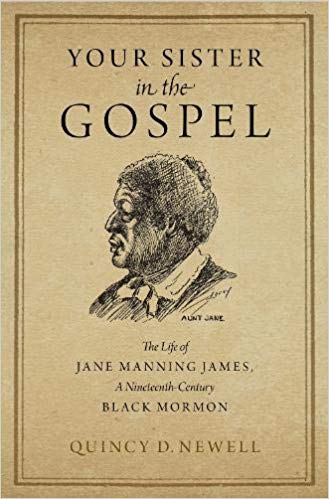 Among the small number of African Americans who converted to the Mormon faith during the nineteenth century, Jane Manning James is perhaps the best known. Born free to a woman who had been born enslaved, Jane’s life exhibited many of the complexities associated with racial discrimination during the era. She joined the LDS church in Connecticut, migrated–mostly by foot–to Nauvoo, lived in Joseph Smith’s home as a housekeeper, and was part of the vanguard company that entered Utah in 1847. She did not die until 1908, which granted her enough time to leave several reminiscences of her unlikely life. By all accounts, her story is a hallmark of dogged faith and preservation.
 Benjamin E. Park