Supreme Court Amicus Brief on Trump, Immigration, and Mormon History

I was very honored to be part of an amicus brief field in the Supreme Court today in opposition to Donald Trump’s proposed immigration ban. You can read more about it here, and below is the press release:

August 17, 2017

MORMON SCHOLARS TAKE THEIR BRIEF AGAINST TRUMP TO THE U.S. SUPREME COURT

Earlier today, a group of 21 scholars of Mormon history filed a brief in the United States Supreme Court attacking President Trump’s ban on refugees and immigrants from six Muslim countries. The brief tells the story of government attacks on Mormon immigration in the 19th century. This history, it urges, shows the need for exacting scrutiny of the order.

During the 19th century government officials repeatedly attacked the Mormons because of their religion. During the 1880s, federal officials explicitly targeted Mormon immigrants. In some cases, Latter-day Saints were refused entry to the country, in others they were jailed by government officials at the border, and at times federal officials pressured Mormon immigrants to abandon their religion and convert to Protestantism.

According to Kathleen Flake, Richard Lyman Bushman Professor of Mormon Studies at the University of Virginia, “While some know that American Mormons were persecuted, few know that Mormon immigrants were refused entry into the US. Remembering this, we have particular reason to challenge the renewal of religious discrimination in our nation’s laws.”

Richard Bushman, an emeritus professor at Columbia University and author of Rough Stone Rolling, the definitive biography of Mormonism’s founder, said earlier, “Most Americans have a story about ancestors who came as immigrants to the United States, many under pressure.  Mormons were among the most reviled when they came. We have to take a stand with those who flee to America as a refuge.”

Some of the scholars gave more personal reasons for joining the brief.  Thomas G. Alexander,  Lemuel Hardison Redd, Jr. Professor Emeritus of Western American History, Brigham Young University, said:

“As a descendant of Mormons who lost their worldly goods and suffered almost unimaginable persecution because of religious prejudice as vigilantes drove them from their homes in Far West, Missouri and Nauvoo, Illinois, I cannot help but deplore a policy that denies one human being the same opportunities as another because of their religion.”

Likewise, Pulitzer prize-winning Harvard historian Laurel said earlier, “Whenever I hear people stereotyped for their religion, I think of my Grandfather Thatcher, who was denied the right to vote when in Idaho in the 1880s, not because he had violated any law, but simply because he was a Mormon. People should be judged on their behavior, not on their identity.”

The brief was written by Nathan B. Oman, a Mormon law professor at William & Mary, and Anna-Rose Mathieson of the California Appellate Law Group LLP.  The scholars were represented before the U.S. Supreme Court by Ms. Mathieson.  Nineteen of the scholars filed an earlier amicus brief before the U.S. Court of Appeals for the Ninth Circuit attacking President Trump’s travel ban.
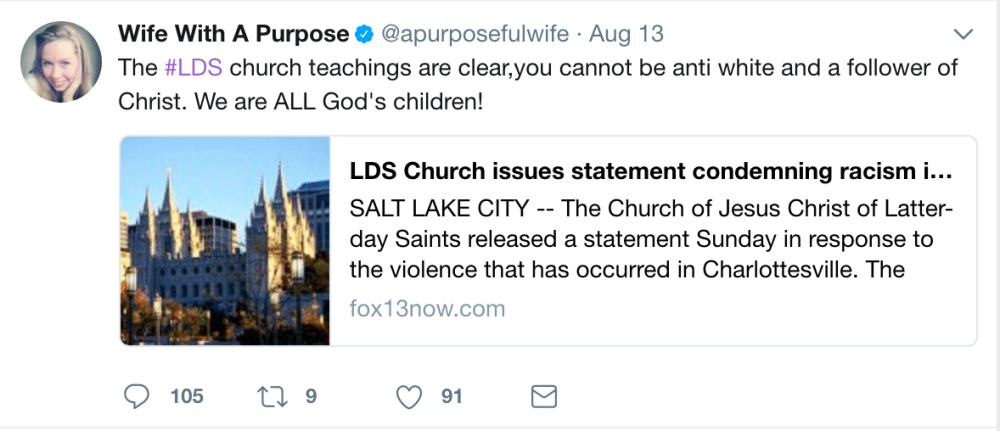
Combating “White Culture” in the Mormon Church

The LDS Church has long struggled to address persistent racial problems within its culture. Even after the Church reversed its official policy in 1978 in order to allow members with African ancestry to hold the priesthood and participate in temple ordinances, remnants of the past age remain. The inability to fully engage these historical foundations has hindered attempts to address problems in the present. One BYU religion professor was caught in 2012 regurgitating dated justifications, which forced the Church Newsroom to release two brief statements that “condemn racism, including any and all past racism by individuals both inside and outside the Church.” But ambiguity still remained. Even the 2013 “Gospel Topics” essay, which is deservedly heralded as a new landmark for situating the racial restriction within its racist context, came short of directly severing the policy from revelatory origins.

Part of this is to be expected. Any direct questioning of past prophetic statements can undercut the authority of modern prophetic authority. And given that Mormonism, at least in America, remains a predominantly white and middle-to-upper-class demographic—and African converts are mostly unaware of the history—there is no direct and pressing need to come to terms with the persistence of white culture.

But the spread of white nationalism that has accompanied the Age of Trump has provided the circumstances necessary for revisiting the issue. A number of self-identified Mormons have received significant attention for proclaiming their white nationalist views, and none of them received official pushback from the Church. One of them was even scheduled to be a speaker at the rally that took place in Charlottesville last weekend. That was perhaps the apex of the movement’s march to mainstream consciousness.

Once that event caused a national backlash, the LDS Church released a timid statement that “people of any faith, or of no faith at all, should be troubled by the increase of intolerance in both words and actions that we see everywhere.” It mentioned a recent prophet’s denouncement of racism, but the entire statement was quite general toward “intolerance and hatred.” And just like how white nationalists in America rejoiced in the lack of an explicit denial from Donald Trump, Mormon proponents of the alt-right on Twitter happily noted that the Church did not explicitly condemn them:

Screen Shot 2017-08-15 at 3.06.24 PM

Mormons noticed. Many petitioned the Church to be more direct in their denouncement of white supremacy. Eventually, the Church updated its announcement on Tuesday with the following direct rebuttal:

It has been called to our attention that there are some among the various pro-white and white supremacy communities who assert that the Church is neutral toward or in support of their views. Nothing could be further from the truth. In the New Testament, Jesus said, “Thou shalt love the Lord thy God with all thy heart, and with all thy soul, and with all thy mind. This is the first and great commandment. And the second is like unto it, Thou shalt love thy neighbour as thyself” (Matthew 22:37-39). The Book of Mormon teaches “all are alike unto God” (2 Nephi 26:33).

White supremacist attitudes are morally wrong and sinful, and we condemn them. Church members who promote or pursue a “white culture” or white supremacy agenda are not in harmony with the teachings of the Church.

This is perhaps the most direct condemnation of white supremacy the Church has ever issued. (Much to some people’s chagrin.)

But perhaps just as important, it was a direct attack on so-called “white culture.” This is one of the rare instances where the Church went beyond what was expected. It even placed “white culture” in scare quotes, implying that such cultural categories are artificial constructions and “not in harmony” with LDS teachings. As depressing as such a realization may seem, this stance is quite progressive when compared to most official positions. And since it was presented by the Newsroom–in many ways, whether good or not, the most authoritative organ of the modern Church–it carries substantial power.

Whether consciously or not, this statement could open the door to new possibilities. Those hoping to reform LDS culture in an attempt to rid it of troubling remnants of “white culture” now have convincing tools with which to do so. Because, as scholars have often pointed out, elements of whiteness are everywhere in Mormon culture: our artistic depictions of divine beings (with a caucasian Godhead), our methods of cultural performance (like dress and grooming standards), or even our religious rhetoric (and its devotion to “whiteness”). These are outward manifestations of systematic cultural institutions. And, thanks to this new statement, they are not as stable today as they were yesterday.

The Church may yet come to the point of directly refuting its racist past and addressing its racial present.

Reflections on the Recent Issue of Journal of Mormon History

I finally go around to reading the most recent issue of Journal of Mormon History. As always, there was a lot to chew on. Here are just a few highlights.

  • I really liked Matthew Dougherty’s sophisticated and provocative article, “None Can Deliver: Imagining Lamanites and Feeling Mormon, 1837-1847.” This essay added a new lens to an important topic, how Mormons conceived of Native Americans, in an impressively theoretical way: the study of emotions and feelings. How did the image of Indians validate Mormon beliefs concerning chosenness and millennial justice? Lots of scholarship has pointed to Mormon alliances with indigenous tribes, something that seemingly makes them unique, but Dougherty convincingly highlights how Mormons appropriated common racial beliefs in doing so. (Including support for forced Indian removal.) And in looking toward the Amerindian apocalypse, Mormons were anxious to cast off the feeling of violent justice off their own shoulders.  “Early stories about Lamanites, then,” the article explains, “did not exalt American Indians above white Mormons but rather suppressed or downplayed Native people’s actual needs in favor of imagining a holy people who could enact Mormon prophesies” (44). Mormon conceptions of interracial unions were complex.
  • I also enjoyed Matthew Godfrey’s “Wise Men and Wise Women: The Church Members in Financing Church Operations, 1834-1835,” which is a straight-forward account of fundraising efforts in Kirtland. It turns out that churches need money to survive, especially if they have grand expectations for audacious projects. As such, the young LDS faith was in constant need for cash. Lacking the business endeavors of the later Utah period, not to mention a standardized system of tithing, they turned to donations. This is where average members came in. I especially appreciated the attention to women, many of whom we know too little about. This is another example of how the large designs of church leaders would not have existed if not for popular support.
  • Some of the best work JMH publishes is outside the narrow boundaries of history. James Swensen’s “Reflections in the Water: An Exploration of the Various Ises of C. R. Savage’s 1875 Photograph of the Mass Baptism of the Shivwit” is a great example. Swensen, who teaches art history, traces the reception history of a famous picture. (It’s the image featured in this post.) Taken when over a hundred members of a local tribe entered the Mormon fold, the image had a long shelf life. To Mormons during the 1870s, it represented a fulfilled promise that the Lamanites would accept the gospel; to gentile observers, it was proof of the Native/Mormon alliance. Later, scholars used it as evidence of cultural imperialism; conversely, others argued it depicted Native People exercising agency and making diplomatic alliances.
  • The other articles are also excellent. Two of them, by Alisha Erin Hillam and Darcee Barnes, were written by independent historians, and represent the broad tent JMH does (and should) create.
  • There is an exceptionally long book review section, which I understand is due to an error. (The reviews from the previous issue weren’t printed, so they were doubled up in this one.) As always, the quality of these reviews can be uneven, but there are plenty of good ones. My favorites were those written by grade students who display an exciting grasp of new historiographies. This includes not one but two reviews by Cristina Rosetti, a PhD candidate at UC-Riverside, as well Joseph Stuart, a PhD candidate at Utah. But also check out Matt Bowman’s thoughtful take on Tom Simpson’s award winning American Universities and the Rise of Modern Mormonism.
  • I especially enjoyed the exhibit review by Richard Bushman, where he reacts to the year-old remodel of the LDS Church History Museum. The prose is quite flowery (the museum could use portions of it for marketing brochures!), but he also raises incisive critiques. (Besides that, as an octogenarian, he missed the old escalators and had to anxiously look for the elevators.) Bushman notes that the museum has a bit of difficulty handling the Book of Mormon. How should one square this ancient record with a modern story? They chose to merely tell it within the context of Joseph Smith’s own life, rather than dwell on its historicity claims. Second, the exhibit demonstrates some transparency (seer stones and polygamy) but in limited ways (doesn’t depict Smith using the stones, and no mention of Smith’s own polygamous practice). And finally, Bushman explains that the new exhibit both condenses and expands the story: condenses, because it cuts the tale off at Nauvoo; expands, because it focuses on he broad concept of visions. “The parochial story of Utah and the gathering gives way to the universal story of a new revelation” (147). I appreciate this take, but I do note the irony that, in a day when the Church History Department is more focused on global stories, the entire first floor of its museum is dedicated to twenty years of an American tale.

Anyways, it’s a solid issue. Happy reading!

Thomas Jefferson, White Supremacy, and Last Night’s March in Charlottesville

Last night, several hundred individuals bearing torches marched on the University of Virginia to protest the removal of Confederate monuments. They chanted “White Lives Matter,” denounced racial diversity, and insisted that white Americans could not be “replaced.” This type of episode has become more common in Trump’s America, as the election of someone who ran a campaign based on deliberate race-baiting has unleashed and justified a torrent of racist actions across the nation aimed to marginalize minority voices. Some observers are consistently shocked at this—they point to the clean-shaven faces, modern clothes, and generally modern appearance of the protesters. One internet meme dubbed them the “Nazis of Pier One Imports.” The constant surprise at these developments, however, belies the persistence of this very tension at the heart of American culture.

That the march took place in Charlottesville, on the campus for a university founded by Thomas Jefferson, is tragically fitting. Jefferson is best known as author of the Declaration of Independence, and the ideal that “all mankind are created equal” is what is still at stake. But Jefferson also authored—as well as enacted—a number of racial beliefs that excluded non-whites from the American political body. Even when he confessed that slavery was a moral wrong, a tenuous position that was always more an abstract ideal for him than a driving principle, he could not envision a mixed-race society. His idea of a nation was rooted in racial homogeneity. In his Notes on the State of Virginia, Jefferson explained why the emancipation of slavery could only be coupled with the forced removal of the black population:

It will probably be asked, Why not retain and incorporate the blacks into the state, and thus save the expence of supplying, by importation of white settlers, the vacancies they will leave? Deep rooted prejudices entertained by the whites; ten thousand recollections, by the blacks, of the injuries they have sustained; new provocations; the real distinctions which nature has made; and many other circumstances, will divide us into parties, and produce convulsions which will probably never end but in the extermination of the one or the other race.

This quote was what immediately came to mind as I looked at pictures of white supremacists marching near the University of Virginia’s Rotunda. Racial tension has always been part of America’s nationalist imagination.

As I have previously written, these racist outbursts have always been central to the American political tradition. Respectable, educated, and, indeed, “modern” individuals have long envisioned a nation based on white supremacy. That included the president whose campus the protestors marched on last night. We won’t be able to address this predominant sin of American racism until we acknowledge how rooted it is in our culture. It will require much more than just historical amnesia to forge a more inclusive patriotism.

Trump’s victory did not reawaken white supremacy, but rather merely provided the cover for its open performance. The national sin of racism has been with us all along, whether we admit it or not.

Reading List for Religion and America’s Founding

This morning I am giving a presentation to teachers from the Conroe Independent School District on religion and the founding. Since I am morally opposed to providing paper handouts, I am posting here the list of resources that I recommend to those who wish to dig deeper into the origins of America’s religious tradition. This list is not exhaustive, but rather introductory.