Review: Jonathan Israel, THE EXPANDING BLAZE

About eighteen months ago I queried at The Junto, “What Happened to the ‘Democratic’ in the ‘Age of Democratic Revolutions’?” The post was prompted by the last decade’s work that seemed to emphasize the conservative twist of the revolutionary movements that marked the last few decades of the eighteenth century. Most of this new work, I argued, broke away from the dominant model of R. R. Palmer’s half-century-old The Age of the Democratic Revolution, which posited this era as the age of modernity’s birth through republican revolt. However, I may have spoke too soon. Within that very year, two new books had just appeared that seemed to revisit the very nature of the age: James Kloppenberg’s Toward Democracy: The Struggle for Self-Rule in European and American Thought (Oxford UP) and Janet Polasky’s Revolutions Without Borders: The Call to Liberty in the Atlantic World (Yale UP). Both books, however, sought to directly challenge Palmer’s classic thesis.

Now, just another year later, however, we have another book to add to that shelf, though this one is more a project of reclamation than replacement.

Jonathan Israel, an emeritus professor at the Institute for Advanced Study in Princeton, recently published The Expanding Blaze: How the American Revolution Ignited the World, 1775-1848 (Princeton UP). In many ways, it is the culmination of a series of significant, dense, and contested works on the enlightenment. Historians of Europe are well-acquainted with his productivity from the recent two decades, especially his sweeping trilogy of the enlightenment: Radical Enlightenment: Philosophy and the Making of Modernity, 1650-1750 (Oxford UP, 2001), Enlightenment Contested: Philosophy, Modernity, and the Emancipation of Man, 1670-1752 (Oxford UP, 2006), and the Democratic Enlightenment: Philosophy, Revolution, and Human Rights, 1750-1790 (Oxford UP, 2011), all of which are rich in details and thick in pages (averaging around 800 pages). Though many historians contest his, well, radical conclusions, these books are standards on many comprehensive exams.[1]

There have been helpful overviews written of Israel’s primary thesis, but for our purpose I’ll only mention his argument that modernity’s origins were found in radical thinkers, most notably Spinoza, who challenged the dominant political, religious, and social structures of the day. They offered a much more materialistic, secular, and egalitarian model for society. This was, indeed, the radical enlightenment. On the other hand, figures like John Locke, typically seen as the heroes, are instead cast as proponents of the “moderate” enlightenment. These moderates blunted, rather than accelerated, democracy’s true origins due to their conservative approach. As you can imagine, this thesis is a touchstone for historians of European thought.

Israel then followed his trilogy up with a volume that left the grand narratives behind and instead zoomed in on the French Revolution: Revolutionary Ideas: An Intellectual History of the French Revolution from the Rights of Man to Robespierre (Princeton UP, 2014). This was a shift in his scope, but one that was meant to vindicate his earlier conclusions. The first few years of the French revolt, he argued, witnessed the climax of the impressive radical enlightenment that came before, only to be squandered by the tyrannical Robespierre who betrayed the movement’s original ideals. Though the volume seemed a natural culmination of Israel’s previous work, some historians argued that his infatuation with ideas blinded him to the work done by France’s commoners. (See, for example, the dialogue here and here.)

But does his model fit onto the American scene?

Israel is not shy in claiming that his work is an inheritor of Palmer’s original thesis that the American Revolution sparked “the origin of democratic modernity.” Indeed, he argues that such an argument, after decades of scholarly challenge from “cultural” historians, “needs vindicating, vigorous reaffirmation, and broadening beyond where Palmer himself took it” (600). In other words, he’s trying to out-Palmer Palmer. And he is far from shy about doing so:

“[The Revolution’s] political and institutional innovations grounded a wholly new kind of republic embodying a diametrically opposed social vision built on shared liberty and equal civil rights. The revolution commenced the demolition of the early modern hierarchical world of kings, aristocracy, serfdom, slavery, and mercantilist colonial empires, initiating its slow, complex refashioning into the basic format of modernity.” (2)

I appreciate a historian who doesn’t mince words.

Like his previous work on the enlightenment, where he posited “radical” versus “moderate” thinkers, Israel breaks the revolutionary debates into two different camps: the aristocratic (or those who believe in a “mixed” government, based on the British tradition, and the social order prevalent before 1776) and the democratic (or those more radical and for equality/emancipation). This is, in many ways, a direct response to Kloppenberg’s recent narrative, which argued that most American revolutionaries fit within rather narrow parameters, most of which were distinct from the French arena. In Kloppenberg’s model, the American democratic tradition was born within its own context.

But Israel is intent in proving the similarities between the American and French revolutionary moments, pursuant to his larger goal of deciphering a broader democratic moment, and to do so he is dedicated to finding practitioners of similar camps on both sides of the Atlantic. What the American Revolution inaugurated, then, was a decades-long fight between the moderates—like John Adams, Alexander Hamilton, and other F/federalists—who drew from Locke and “constituted an absolute obstacle to the forming of democratic society” (91) and the radicals—like Thomas Paine and the young Thomas Jefferson—who truly tried to reform society. By expanding the boundaries of debate, Israel hopes to cast the revolutionary net much broader.

But for such a wide net, The Expanding Blaze is surprisingly dedicated to only a few fish. If Israel is devoted to reclaiming Palmer, he is similarly eager to resurrect Paine. Indeed, Paine receives more analysis than anyone else in the entire volume. This should be expected, as Paine is an easy link between the American and French conflicts, as well as an easy figurehead for the more radical ideas of the era. But the degree to which Israel tethers his thesis to Paine is somewhat surprising: Thomas Jefferson’s refusal to follow Paine’s path, for instance, makes America’s third president a tragic figure in this story, a politician who sells his radical soul in his quest for moderate governance. After 1800, when Jefferson rejected Paine’s radical ideas and instead pushed America into an expanding, slaveholding empire, he entered “into an ideological and political retreat and minimalism with profound implications for the future” (395).

And this was the route for the entire nation: America, once birthed through a radical hope of regeneration, eventually settled into a much more mundane nation no longer the leading light for other nations. Only Paine survives this conservative turn unscathed, which leaves the reader to wonder how deep (let alone cohesive) the radicalism was in the first place. Further, this retrenchment narrative can only work when privileging certain individuals and events over others: for example, Israel devotes ten pages to discussing Paine’s Common Sense, but only two to the Constitutional Convention. Only one of these documents provides a radical beginning to the nation.[2]

Writing fifty years after Palmer, Israel is willing to take into account the very types of historical topics his predecessor avoided. For instance, The Expanding Blaze is attuned to the Haitian Revolution, the presence of slavery, and problem of Indian removal, all of which were avoided or downplayed in Palmer’s account. In Israel’s narrative, each of these topics received their own (condensed) chapter, though one might argue that by segregating these thorny topics was a way to leave his radical democracy thesis untouched. In the case of African and Native Americans, Israel’s chapters mostly remain in the ideological realm without ever touching on the reality. “Inevitably,” he argued, “the American Revolution’s core values, given their content and scope, were to some extent bound to encourage, reinforce, and broaden the movement to weaken and abolish slavery in the Americas and the rest of the European colonial world” (141). Perhaps, but it sure didn’t work out that way. The perpetuation of slavery, according to Israel, was a betrayal of the Revolution; this argument, however, ignores the fact that, for many, the latter was meant to assure the former. Further, in tracing the radicalism of the era, Israel never engages non-white voices like Olaudah Equiano.[3]

Perhaps in response to the critics of his volume on the French Revolution, Israel is also much more eager to discuss the common soldiers and their role in the Revolution. His attempt at exhaustiveness is to be commended. But he is also anxious to cordon non-elites off into a particular category for analysis. Common Americans did the brunt of the work, he admits, but they “were not equipped to convert a wider strategy or draw up a political and constitutional plan. Their energy was crucial but also undirected, unruly, and potentially counterproductive” (38). It was left to the leaders, therefore, to guide the revolutionary spirit, by “capturing, taking charge of, and interpreting the disc content generated by social and economic pressures” (14). Cultural historians will probably not be persuaded by this hedge, but Israel is at least attempting to find a middle ground.[4]

I’ll close this overly-long review by doing the selfish thing of highlighting portions that relate to my own forthcoming book. (If I’m up-front with the megalomaniac critique, is it still bad?) Most especially, I was surprised at his dismissal of two elements I find quite essential to the “radical” revolutionary debates: nationality and religion. Israel argues that “nationalism” was not a significant term until the post-1815 era, a claim that overlooks the fact that most early conceptions of democracy were rooted in how people conceived of a national body. The term certainly evolved at the beginning of the nineteenth-century, of course, as its connection to the nation-state was constantly in flux, but early American political discussions were rife with appeals to nationality. Second, Israel often frames religion as a moderating force meant to curtail democracy’s excesses. The conservative turn, he claims, was attached to Americans’ “new religiosity” that curbed the radicalness of previous decades (400). While that is, to some degree, true, and such an argument reflects Israel’s grander theory of secularization at the heart of the radical enlightenment, it downplays the democratizing force religion was to many of America’s earliest radical voices.

I admit that I was skeptical going into The Expanding Blaze, expecting it to possess some of the same problems as Israel’s Revolutionary Ideas. And to some extent, I found what I was looking for. But I was also surprised how much I enjoyed the volume—enjoyed arguing with it, sure, but I also genuinely enjoyed the deep analysis of particular texts and individuals, also a hallmark of Israel’s previous work. There were certain chapters that I felt broke new ground, like his examination of American pursuits for universal education, as well as his overview of the American Revolution’s influence on Ireland’s conflicts in the 1780s and 1790s. And even if his attempts at satisfying the critiques of cultural historians may come up short, they were attempts nonetheless. Overall, it is a very helpful compendium of debates over democracy during America’s founding half-century.

Israel’s The Expanding Blaze is, in the end, truly the successor to Palmer’s The Age of the Democratic Revolutions, in terms of both its strengths as well as its weaknesses. But even further, it is also reflective of the historiographical developments that took place in the fifty years in-between.

_________________________________

[1] Israel helpfully summarized most of the books’ arguments in a condensed volume, A Revolution of Mind: Radical Enlightenment and the Intellectual Origins of Modern Democracy (Princeton UP, 2009).

[2] Israel is not alone with this retrenchment narrative, of course. Seth Cotlar’s excellent Tom Paine’s America: The Rise and Fall of Transatlantic Radicalism in the Early Republic (UVA Press, 2011), makes a similar argument, though ironically with the type of cultural analysis Israel avoids.

[3] For a narrative that includes more diverse voices, see Polasky’s Revolutions Without Borders.

[4] Some might also be non-plussed with his claim that historians have been “distracted by the ‘cultural turn,'” whose “historiographical one-sidedness, prioritizing popular and mass attitudes over intellectual debates, encouraged oversimplification by largely ignoring the role of conflicting philosophies and ideologies intellectually grounding and shaping, though not socially driving, the American revolution and call the revolutions of the age” (13).

Your Holiday Sale for Academic Books Guide

In a couple weeks I’ll post my favorite year-in-review lists—on early American history at Junto, and Mormon history at Juvenile Instructor—but today I thought I’d highlight some great sales going on with academic presses. Who could down a holiday discount? (A big shout-out to William Black, who listed a lot of the press sales on twitter.)

First and foremost, if you’re reading this blog, I hope you’ve pre-ordered American Nationalisms: Imagining Union in the Age of Revolutions, 1783-1833 (Cambridge University Press), of which I’ve heard great things. Use code “BPARK2017” for 20% off. You’ll be hearing more about this soon—I promise.

Okay, on to the holiday deals.

Perhaps the biggest sale is with Oxford University Press, where you can get 50% off most of their books. Since this year is the big anniversary for the Reformation, I’ve enjoyed Peter Marshall’s 1517: Martin Luther and the Invention of the Reformation and Craig Harline’s A World Ablaze: The Rise of Martin Luther and the Birth of the Reformation. If you’re into the Caribbean, check out Terry Rey’s The Priest and the Prophetess: Abbé Ouvière, Romaine Rivière, and the Revolutionary Atlantic World and Katherine Paugh’s The Politics of Reproduction: Race, Medicine, and Fertility in the Age of Abolition. (And if UPenn starts a sale, make sure to check out Sasha Turner’s Contested Bodies: Pregnancy, Childrearing, and Slavery in Jamaica.)

For early America, I really enjoyed Michael Klarman’s The Framers’ Coup: The Making of the United States Constitution, and have already preordered Christopher Grasso’s Skepticism and American Faith: From the Revolution to the Civil War. If you haven’t read Rachel Hope Cleves’s Charity and Sylvia: A Same-Sex Marriage in Early America, then this is your year. And if you pre-order Kathryn Gin Lum and Paul Harvey’s Oxford Handbook of Religion and Race in American History, it will only cost you one child.

The Omohundro Institute’s series on early America is the most consistently mind-blowing series out there, so it’s a good idea to stock up on their books while you can get the 40% off deal. (Just type in “01Holiday” at checkout.) I recommend Douglas Winiarski’s Darkness Falls on the Land of Light: Experience Religious Awakenings in Eighteenth-Century New England, Robert Parkinson’s The Common Cause: Creating Race and Nation in the American Revolution, and Gideon Mailer’s John Witherspoon’s American Revolution, all of which published in the last couple years.

UNC Press also had a series of great books in American religious history in the past year. Get 40% off on Max Mueller’s Race and the Making of the Mormon People, Rachel McBride Lindsey’s A Communion of Shadows: Religion and Photography in Nineteenth-Century America, and Tisa Wenger’s Religious Freedom: The Contested History of an American Ideal.

There’s never a bad time to catch up on some classic texts on American slavery. You can’t go wrong with Robin Blackburn’s The American Crucible: Slavery, Emancipation, and Human Rights for 60% off. Over at LSU Press, if you enter “04Gift,” you can get Caleb McDaniel’s The Problem of Democracy in the Age of Slavery for 40% off.

And then there are Mormon history titles. From Oxford, you should already own Paul Reeve’s Religion of a Different Color: Race and the Mormon Struggle for Whiteness, Joanna Brooks et. al.’s Mormon Feminism: Essential Writings, and Patrick Mason and John Turner’s Out of Obscurity: Mormonism since 1945, but if you don’t own all of these, now is your time to repent. You can also pre-order Jonathan Stapley’s game-changing The Power of Godliness: Mormon Liturgy and Cosmology and the edited collection Foundational Texts of Mormonism, the latter of which you need the discount to make it fit within your budget.

You can get 30% off of titles at the University of Illinois Press, whose Mormon studies list is an embarrassment of riches. For starters, I recommend this one, this one, this one, and this one. A similarly mind-blowing Mormon history list is found at the University of Oklahoma Press. All history buffs should have a complete set of Kingdom in the West books, some of which are now in paberback for the first time.

If you’re interested in Mormon cultural work, there is plenty to enjoy. The great people at BCC Press, is running a crazy sale on all their titles. I could recommend all of them, but of special note is Rachel Hunt Steenblik’s beautiful collection of poems on heavenly mother (for six dollars on Amazon!) and Tracy McKay’s moving memoir The Burning Point: A Memoir of Addiction, Destruction, Love, Parenting, Survival, and Hope (for eight dollars!). And if you’re into Mormon scriptural studies, Kofford Books is doing a 40%-off sale on all their work in that field, including David Bokovoy on the Old Testament and Michael Austin on Job.

Happy shopping!

D. Michael Quinn, Mormon Capitalism, and New Mormon History

Few figures have been as paramount to the cultural history of Mormon scholarship as D. Michael Quinn. To some, he is an icon who fought for a more professional history and honest approach to the past; to others, he is a critic who fudges facts in order to present a polemical front. To everyone, his monumental texts are a must-read for those who wish to understand both Mormonism’s past as well as the politics of producing Mormonism’s past in the present. Though circumstances have left the community devoid of Quinn’s work for much of the past two decades, the publication of his long-anticipated The Mormon Hierarchy: Wealth and Corporate Power (Signature Books), the third volume in a series that dates back to the 1990s, gives occasion to reassess his immense contribution. It also provides a chance to engage the historiographical movement he represented.

Quinn was a researcher for Leonard Arrington’s “Camelot” division during the 1970s, during which time he also received a PhD in history from Yale and began teaching at Brigham Young University. He then proceeded to publish an extraordinary stream of significant articles on a wide range of topics, notably prayer circles, the succession crisis, and, most controversially, post-manifesto polygamous unions. Due to increasing pressure both inside and outside BYU, he resigned his position in 1988, the year after he published his first major book, Early Mormonism and the Magic Worldview.

Now liberated as an independent historian, Quinn unleashed a publishing streak rarely rivaled in the field. Over about a decade, he produced, with Signature Books, two substantial volumes in the Mormon Hierarchy series, a revised and enlarged version of Early Mormonism and the Magic Worldview, as well as a biography of twentieth century Mormon leader J. Reuben Clark (an expanded and revised version of a smaller book he wrote a decade earlier). He also published his first (and thus far, only) book with a university press, Same-Sex Dynamics Among Nineteenth-Century Americans: A Mormon Example (University of Illinois Press). These remain significant volumes within the world of Mormon history.

What made this productivity even more noteworthy was it took place amidst growing cultural controversy. Due to a confluence of events, Quinn was among the “September Six” who were excommunicated in 1993. As a result, Quinn was now a cultural icon, frequently speaking about and writing on his journey from BYU professor to infamous dissident. Stories were written about how Mormon money prevented him from gaining new academic appointments. (Though the parochial nature of his work likely also played a role.) The momentum could only last so long, however, as his publications tailed off after the Clark volume in 2002. Interest has been piqued once again in recent years, with a notable essay in Slate (see also my reflections here), as well as the MHA awarding him the prestigious Arrington Award (fore lifetime accomplishments) in 2016.

And now we finally have the third volume for his Mormon Hierarchy series, titled Wealth and Corporate Power. The book is made up of three essays and twenty-one appendixes, and it tells the story of how the LDS Church transformed from an institution struggling for cash to a global conglomerate with billions of dollars in revenue. Chapters deal with such things as the wealth and finances of Church leaders—allowances for leaders were not standardized until the 1960s, and many were involved in other corporations until that time—as well as the numerous (and often staggering) church-funded organizations that dotted first Utah and then, later, the broader nation and world.

Quinn’s traditional strengths are on full display in the volume. His familiarity with a host of archival sources—many of which later became restricted—is unmatched, and I learned a lot of new things I hadn’t considered before. As with the other volumes in the Mormon Hierarchy series, Quinn is able to offer an unprecedented look into the dynamics, personalities, and conditions of LDS leadership. In an era dedicated to transparency, and increasingly obsessed with the use and abuse of money, the details provided in this book are crucial.

But Quinn’s work also reveals the marks of his own era. The primary goal is often to present undigested information rather than craft a persuasive narrative, argument, or interpretation. Perhaps even more than the series’ other volumes, this work bounces between decades and even generations, often within the span of a few pages. (See, for example, his discussion on how Mormons used the term “business” on pages 50-51, or footnote 12 for chapter 2 which is a long—and tangential—discussion of alcohol.) Some of the chapters end abruptly, even without a conclusion. Once dissected, it is clear Wealth and Corporate Power is mostly dedicated to presenting as much raw material as possible: in a 600 page book, once you exclude the endnotes and (extensive) appendixes, there are only 110 pages of actual analysis. To an extent, this book should be categorized as an annotated bibliography.

This approach is reflective of its historiographic origins. And as with many texts in New Mormon history, details often take precedent over context: Quinn is reticent to cite the broader American environment in which these activities take place. Readers hardly ever get a sense of whether what is going on within Mormonism is reflective of or divergent from America writ large.

Which is a shame, because to paraphrase the wise Mugatu, the study of business and religion is so hot right now. There has been a litany of recent books, included an essay collection that reflects the vibrancy of the field. The new wave of Mormon Studies, built on the shoulders of New Mormon History, is dedicated to demonstrating how Mormonism can shed light on these broader cultural trends. There is still a lot of work to do when it comes to the LDS Church and twentieth-century corporate culture. Future historians will have to take the material provided by Quinn in the quest to tell the larger story.

So, in a way, Quinn’s work is simultaneously reflective of where the Mormon history field has been as well as where it is yet to go. Yet even while his books, including Wealth and Corporate Power, are ill-fit for the historical field today, the fact that they remain important for historians demonstrates his prolonged significance. That academics still engage his work, despite its dated methods and lack of conclusions, is a major accomplishment in its own right. The Mormon Hierarchy series might not make it on any syllabus, but its volumes will likely be found on the bookshelves closest to the historian’s desk.

They certainly are on mine.

[BTW: you can listen to a good interview between Quinn and RadioWest here.]

Joseph Smith, Sarah Ann Whitney, and the Familial Dynamics of Nauvoo Polygamy

[The great people at the Joseph Smith Papers Project keep rolling out newly digitized documents onto the website. Last year they uploaded several new caches from 1843. Included in that bunch was a blessing for Sarah Ann Whitney, a plural wife of Joseph Smith, dated March 23 and written in Smith’s own hand. Very few people were aware that this document existed. This post seeks to briefly explain and partially contextualize the circumstances that led to the blessing’s creation.]

Sarah Ann Whitney grew up knowing and revering Joseph Smith, the Mormon prophet. Her parents, Newel K. and Elizabeth Ann Whitney, were some of Smith’s earliest converts; Newel soon became the second bishop in the church, and Elizabeth was one of the founders of the Female Relief Society. In Nauvoo, the Whitneys were royalty.

It was logical, then, that Newel and Elizabeth were some of the first people Smith told about a new doctrine allowing polygamy. They were at first shocked, but eventually accepting. And then, “laying aside all our traditions and former notions in regard to marriage,” Elizabeth later wrote, they consented “to give our eldest daughter, then seventeen years of age, to Joseph, in the order of plural marriage.” Sarah Ann, their second child and first daughter, was to be wed to the prophet of her youth, a man twenty years her senior.

The sealing between Joseph Smith and Sarah Ann Whitney took place in secret on July 27th, 1842. It is the only polygamous sealing from Nauvoo where participants left a written record of the ritual. This document, framed as a revelation, is perhaps the best insight into the dynastic theology upon which polygamy was based. It was written in the voice of God and directed to Newell Whitney, and instructed him on how to perform the quixotic nuptials between his daughter and Smith. “They shall take each other by the hand,” it explained, “and you shall say you both mutually agree calling them by name to be each others companion so long as you both shall live.” The sealing promised “honor and immortality and eternal life” to the entire Whitney household. Sarah Ann was merely a link in a chain that bound the Smith and Whitney families, an assurance of salvation for Newell and Elizabeth, their ancestors, and even their progenitors. By attaching themselves to the royal lineage of Mormonism’s prophet, the Whitney family found eternal stability.

Smith, in turn, relished the new association. It was a period where he needed moral support. The next month, while he was in hiding to escape extradition charges, Smith wrote a letter pleading for Newel, Elizabeth, and Sarah to come visit him at his secret hideout. Yet he knew the scandal involved, especially if his wife Emma found out. “The only thing to be careful of,” Smith cautioned, “is to find out when Emma comes,” because it “cannot be safe” if she were present. Clandestine relationships during tense situations required secret rendezvous. Smith often wore his emotions on his sleeves, and this letter demonstrated that his lust for kin extended to polygamous families. He certainly knew it was scandalous: Smith urged the Whitneys to “burn this letter as soon as you read it.” Besieged from all sides, Smith was earnest enough to take risks.

But the Whitney family had its own struggles. The decision to seal their daughter to Smith caused Elizabeth great agony. Not only was she Sarah’s mother, but she was a good friend to Emma, with whom she helped organize the Relief Society only a few months previous. Now she was helping orchestrate covert meetings between her daughter and her prophet. She later admitted “how bad she felt when Joseph Smith first broched [sic] the subject to her,” and “how she cried about it but the Prophet at last obtained her consent.” This was an anguishing ordeal. Nor was Elizabeth the only family member to have doubts: Smith asked the Whitney parents to keep the marriage secret from their son Horace, whom Joseph feared would cause “serious trouble.” This was a hard strain on a family that had already sacrificed much for the faith.

But then, of course, there was Sarah herself. Only seventeen years old at the time, and by all accounts well liked by her peers, this was an event that would change the course for her whole life. Even while she was initiated into the Mormon church’s inner circle, and linked forever to the faith’s prophet, she must have known that she risked alienation from everyday life. Could she survive as the secret wife of an already much-married man? There had to be compensation. Six weeks after the secret sealing, and two weeks after Smith’s request for a clandestine meeting, Smith deeded to Sarah a lot of land only one block from his own. It was rare for a woman to own land in Nauvoo, especially a woman as young as Sarah; indeed, it was so rare that whoever filled out the deed had to strike out “his” and write in “hers” to match the inheritor’s gender.[1]

But land would not be enough. Financial security, however tenuous, was one thing, but Sarah’s social life was now exceptionally more complicated. As a secret bride of the prophet, she was not available for courtship on the very eve of entering womanhood. Beyond the disappointment of having no future marital prospects, her single status coupled with a refusal to consider suitors was bound to raise suspicions.

A solution was struck the following spring. Her sister, Caroline, died while giving birth that October, leaving her husband, Joseph Kingsbury, a widower. He was crestfallen and left to raise their young son. But Joseph Smith made the most of the situation: he proposed a civil union between Sarah and Kingsbury. This would officially take Sarah off the market, and in return Smith promised Kingsbury the chance to be sealed to his deceased wife. “Thy companion Caroline who is now dead,” the prophet blessed Kingsbury in late March, “thou shalt have in the first Reserection [sic].” By helping Smith handle a difficult situation, Kingsbury was rewarded by being one of the very first Mormons to be sealed to a deceased spouse. Smith officiated over what Kingsbury later called a “pretended marriage” between him and Sarah the following month.

Kingsbury was not the only person to receive assurances from Joseph Smith, as Sarah also required extensive support. It had been seven months since she had been sealed to the prophet. Perhaps the young bride felt regrets, especially when she turned eighteen on March 22nd. Though just entering adulthood, in many ways she had already sacrificed much of her future life on behalf of her family. Was she destined to live her life as a sacerdotal martyr? The day after her birthday, therefore, at the same meeting where Smith and the extended Whitney family agreed upon the “pretended marriage,” Sarah received a blessing that reaffirmed the significance of her ritual the previous summer.[2]

The blessing promised Sarah that, due to her attachment to the prophet, God would “crown her with a diadem of glory in the Eternal worlds.” But the promises were not restricted to herself. If she remained committed to the new covenant, “all her Father[‘]s house Shall be Saved.” This was a heavy assurance. Perhaps taking into account her brother Horace, whom they were still worried would be enraged with the clandestine union, the blessing promised that “if any [of the family] Shall wander from the foald [sic] of the Lord they shall not perish but Shall return.” Due to her sealing to Smith, Sarah’s entire family was guaranteed salvation, including those who fell away from the faith. In an era where Americans of all denominations worried about the state of their own soul, the whole Whitney dynasty was promised a heavenly reward. Perhaps Sarah’s sacrifice was worth the cost.[3]

Screen Shot 2017-10-15 at 11.26.45 PM

Joseph Smith’s blessing of Sarah Ann Whitney, in Joseph Smith’s handwriting. Please click on the link above to see a high-resolution scan on the Joseph Smith Papers website.

Hearing the blessing was not enough–Sarah wanted it in writing. Perhaps that would make it feel more real. Early Mormons believed in a literal Book of the Lord, after all, where written records inaugurated eternal heavenly rewards. Whether by his own volition or at Sarah’s request, Smith penned the blessing on a intricate stationary that included an ornamental shape and subtle yet defined borders. Given the prophet rarely wrote anything in his own hand, this was indeed a rare document. For Sarah, it was likely sacred–the only tangible evidence she had for the many metaphysical promises.[4]

Sarah cherished the document enough that it remained within her family’s possession for nearly a century. To the Whitneys, both those in Nauvoo as well as those who came after, it was prophetic and authoritative proof of their family’s election. To Sarah, though, it must have felt bittersweet: it represented both the life she gave up, as well as the many lives she might have saved.

Polygamy in Nauvoo was a harrowing ordeal. Especially for those women who risked their reputation, stability, and future in order to secretly enter these secretive plural unions, it must have seemed impossible to find a sense of strength. To a large extent, they lacked both power and control over their own lives. Sarah Ann Whitney’s blessing document, however, represents the type of assurance they fought for in return. Sarah made sure she had a receipt for her sacrifice. As such, her blessing is a document imbued with the deep tensions that pervaded the culture in which it was constructed.

_____________________________

[1] While the land deed states that the property cost one thousand dollars, a figure slightly higher than most plots sold that year, it is very unlikely that Sarah herself paid that amount. It is possible that Sarah’s parents provided the money, or that Smith merely covered it himself but desired not to leave a paper trail.

[2] I conclude that it was at a meeting on March 23, 1843, that Joseph Kingsbury and Sarah Ann Whitney agreed to be civilly wed based on the fact that both received significant blessings that day. In response to their concession, they were each promised what they desired: Joseph would be sealed to his deceased wife, and Sarah was assured salvation for her whole family. This meeting, in other words, reaffirmed the promises made to the Whitney family during the marriage ritual the previous summer.

[3] This blessing likely served the basis for the famous refrain of Orson F. Whitney, Sarah Whitney’s nephew: “The Prophet Joseph Smith declared-and he never taught more comforting doctrine-that the eternal sealings of faithful parents and the divine promises made to them for valiant sevice int he Cause of Truth, would save not only themselves, but likewise their posterity. Though some of the sheep may wander, the eye of the Shepherd is upon them, and sooner or later they will feel the tentacles of Divine Providence reaching out after them and drawing them back to the fold. Either in this life or in the life to come, they will return.” This passage was frequently quoted by LDS leaders for decades, but has recently been challenged by Apostle David A. Bednar, who claims it does not accurately reflect Joseph Smith’s thinking. Perhaps the release of this 1843 document, which ties the idea to Joseph Smith’s own hand, will lead to a resurgence of the theory.

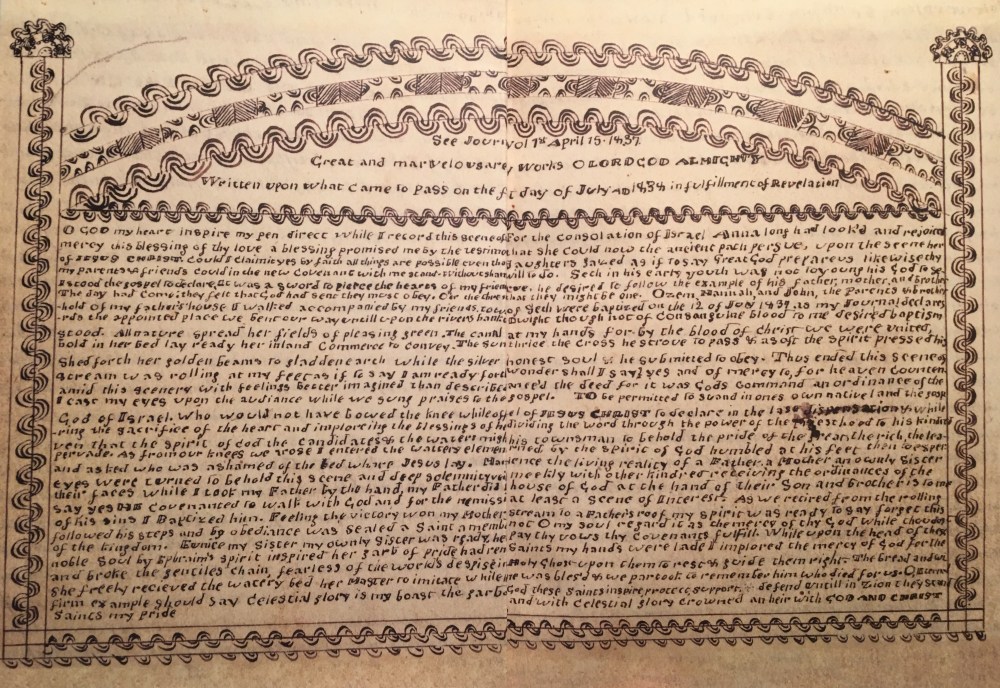
[4] Without examining it in person, and until the great JSP editors do more work, I can’t tell whether the paper on which the blessing was written was originally designed that way or if someone, like Sarah, carefully trimmed the page and sketched the borders. I look forward to someone performing a deep analysis of this just-released document, hopefully drawing from the tools of material culture. Though not nearly as ornate, the blessing slightly reflected Wilford Woodruff’s journal entry detailing his own family’s salvation when his parents and siblings were baptized:

Woodruff

Entry from Wilford Woodruff’s diary detailing his family’s conversion and baptism. This image comes from the frontispiece of Laurel Ulrich’s new book, A House Full of Females.

Gendered Power in Nauvoo…Presented in Nauvoo!

Today I’m catching a plane to St. Louis, followed by driving a rental car up to Nauvoo. I’m excited. Well, I’m always excited to visit Nauvoo, but I’m especially excited to head up there this weekend to present a paper in the annual John Whitmer Historical Association conference. JWHA is a fun organization dedicated to tracing the history of Mormonism’s many divergent branches. You can find the program here.

I will be presenting a paper on how power operated in Nauvoo. More specifically, I’ll be arguing that gender played a mostly underrepresented role in the city’s political culture. Here’s a taste from the introduction:

Why weren’t women allowed in the Council of Fifty? This seems like an odd question to ask. But I’d argue the answer isn’t as apparent as you’d think. In a way, this paper is a long answer to that seemingly simple question.

Scholars of Mormon Nauvoo often create their historical figures after their own likeness and image, male and female. The story about male Nauvoo concerns visions of deification, tampering with elections, introduction of secret rituals, manipulating the economy, and establishing a theocracy. In short, it’s a story about power. The story about female Nauvoo is about the disruption of domesticity, the practice of ritual healing, the formation of the Relief Society, and the acceptance (or rejection) of polygamy, all of which relied upon working within a patriarchal framework. In short, it’s a story about submission. The separate spheres model is seen in comprehensive overviews of the city, as they are mostly structured around framing questions that requires the Relief Society to receive its own, segregated, chapter. It is also prevalent in how we conceptualize how power operated in Nauvoo, since we generally conceive of it in a way in which power flowed in a single direction.

But historical models that fail to recognize the dynamic interplay between men and women in Mormonism’s Nauvoo project tell an imperfect story. Or, at least, an incomplete story…I want to show how the Relief Society’s actions in Nauvoo played a significant role in stories typically seen as predominantly male: electoral politics and the Council of Fifty. Neither of these two topics—the creation of a controversial political system that infuriated non-Mormon neighbors and the formation of a clandestine theocratic body destined to rule the world—typically feature many female voices. But I’d like to show that neither of these developments can be properly understood without demonstrating the role that female involvement played in both these initiatives. And more specifically for my purposes, I want to demonstrate that the way gendered power operated in Nauvoo did not work in a direct path, but rather in a cursory—and sometimes circular—pattern.

What makes me even more excited is I get to deliver this paper in the Red Brick Store, a recreation of the same building in which the Relief Society was formed. Should be a fun time.