Analyzing White Trash in the Age of Trump

I recently breezed through Nancy Isenberg’s recent White Trash: The 400-Year Untold History of Class in America (Viking Press), which is both imminently readable and immensely smart. It is also incredibly relevant. Her argument is simple: the image of a poor, lazy, and immobile class has long been a potent problem in American culture, a constant reminder that “the poor are always with us” and that class hierarchy is always present. This base of people–or at least the fear of them–has been a motivating factor since the colonization period through the present. As actors themselves, the “white trash” have both attempted, at various times and to varying degrees, to reclaim their identity and proclaim their heritage. And at certain points, they can be mobilized as a political force. 

And Trump’s core message is nothing if not an appeal to the anxieties and desires of poor white people. Unlike Romney, he’s not explicitly drawing from rich Wall Street executives–as seen by Michael Bloomberg speaking at the DNC this year–nor is he pledged to mainstream conservative pundits, as seen by Ross Douthat’s disillusionment. Rather, he stokes the fears of those who have been cast as “losers” their whole lives, those who feel they have been disenfranchised, ignored, and dismissed. Trump promised them he’ll restore their honor and redeem their heritage. A common adage of his most devout followers is that Trump “says what he thinks,” which is of course rubbish–Ted Cruz said what he thinks–but they love to hear someone express the same concerns, judgments, and ideas that has been mostly banished from polite society. 

The obvious irony, of course, is that Trump was born with a golden spoon and has made a career of taking advantage of the poor in attempt to cater for the rich. But this quixotic bedfellows relationship only proves both the malleability and potency of this cultural legacy. 

By the way, I hope that the moniker “Age of Trump” won’t last that long. But even if Trump loses this Fall–far from assured, sadly–Trumpism will, just like the poor, always be with us. 
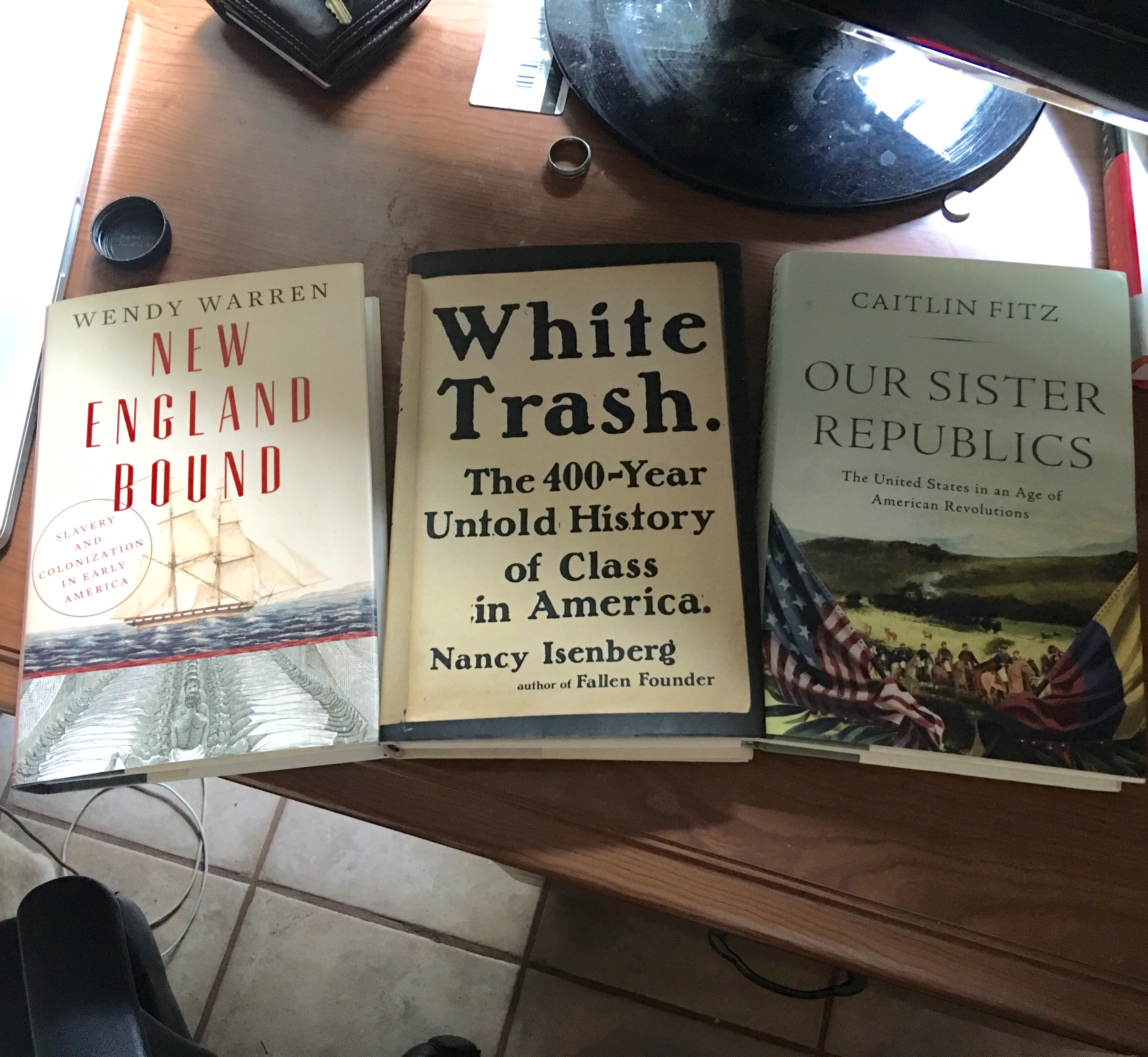
New Book Arrivals, July 2016

One of the best parts of returning from a trip is finding books that you had pre-ordered and promptly forgotten. Nancy Isenberg has become even more recently with her sharp (if somewhat overstated) critiques of the Hamilton musical, but she’s always been one of the wisest commentators on American political and social history; I’m quite excited to dig into her history of “white trash.” 


I had the privilege of meeting Caitlin Fitz at a Kinder colloquium last year, where we workshopped the final chapter of her new book. It was very good, and her recent Journal of American History article on nationalism and the War of 1812 was also wonderful. I expect nothing less from this book, and it’s especially relevant to me given its relation to my manuscript on early American nationalism. This is a great time to be working on the Age of Revolutions, which I’ve blogged about a couple times this year. 

I don’t know much about Wendy Warren and her new book on colonial New England’s connection to slavery, but I’m sure it will help further the recent drive to demonstrate how deeply enmeshed slavery was in early America. I’m sure Bill O’Reilly will love it. 

I’m especially glad to see all three books published by trade presses. A good sign, methinks. 

A Review of Baker and Edelstein, eds., SCRIPTING REVOLUTIONS

Last week my review of Keith Michael Baker and Dan Edelstein, eds., Scripting Revolution: A Historical Approach to the Comparative Study of Revolutions (Stanford University Press, 2015) was published by H-Diplo. You can read the entire thing here.

In general, I really liked the book and found it quite useful. (I’m a sucker for theoretically rich accounts that take a broad look at historical phenomena.) I especially found the editors’/authors’ use of “scripts” as an explanatory framework to be quite useful, and I even used it last semester in my graduate seminar on the Age of Revolutions. I heartily recommend the volume.

The topic seems especially pertinent for today’s age, and indeed was inspired by current tensions. Here’s how I open the review:

If the recent Hamilton play is any indication, there is still a cultural appetite for revolutions. In a way, this has always been the case. But the idea of “revolutions” has received renewed attention in recent years following the political unrest that spread across Tunisia, Egypt, Libya, Syria, and other nations, now known as the Arab Spring, and many wondered if the new possibilities made available through social networking have opened a new chapter to story of revolutionary protest. Time’s “Person of the Year” in 2011, for instance, was “The Protestor,” a fill-in for the many groups who sought to overturn governments and power structures around the globe. On the one hand, there seems to be something universal about this type of unrest, both in the sense of a cultural moment that can be captured in an “Age of Revolutions” framework that emphasizes connectivity and comradeship, but also through transgenerational principles related to humanity that evade circumstance and context. Yet on the other hand, each revolution seems rooted in a particular time and place, the result of parochial decisions and actions that tether the revolt close to home.

Also, it had to be cut due to H-Net’s formatting, but I originally wanted this excerpt from the musical Hamilton to serve as an epigraph:

And? If we win our independence?
Is that a guarantee of freedom for our descendants?
Or will the blood we shed begin an endless
Cycle of vengeance and death with no defendants?

Viva la revolutión!

Frederick Douglass and the Long History of #BlackLivesMatter

We have witnessed two black men executed by white cops over the last two days. This of course isn’t new–the only novel elements are the cell phones that documented the circumstances and the social media that spread the details. They widen the field of knowledge and community of suffering that was previously relegated, by design, to the fringes of society. Indeed, #PhilandroCastile and #AltonSterling are just the most recent examples of a long tradition that far preceded hashtags. Here is an excerpt from Frederick Douglass’s famous narrative, in which he discusses a lack of justice for slaves in Maryland that extended all the way to the destruction of their bodies:

I speak advisedly when I say this,–that killing a slave, or any colored person…is not treated as a crime, either by the courts or the community.

Sound familiar? Even if the legal system that allowed slavery and perpetuated the ownership of black persons was done away, the code that replaced it was malleable enough to maintain the general degradation of black bodies–either through structural policies like the Jim Crow era, or the selective enforcement like the Age of Ferguson. 

The story of America is a narrative riddled with the dehumanization of black bodies–for profit, for power, for control. To ask for examples of white supremacy within America is to ask for examples of water drops within an ocean: those who know what to look for can’t see anything but, and for those who are susceptible to its dangers are crushed by its weight. American progress is often defined as a trajectory of improvement, but it is also a series of transformations from one brutal regime to another, racial superiorities by another name. 

Digital media provides harrowing documentation of this story, but it is merely shining new light on an old core central to the American experience. 

The Pennsylvania Evening Post Declares Two Independence Declarations, July 1776

This is one of my favorite images to share with students when discussing America’s founding. On July 2, 1776, the Pennsylvania Evening Post included notices for two declarations of freedom that had taken place in Philadelphia: the first was the Continental Congress declaring “the UNITED COLONIES FREE and INDEPENDENT STATES”; the second was a runaway notice for “a Negro man named ISHMAEL,” who declared his freedom by escaping his master. The first act, of course, was to be celebrated; the second, punished. The ironies of America are usually like that.

It is an important reminder that we often like to think of things like “liberty,” “freedom,” and “rights” to be self-evident and easily assumed, but those terms are almost always tied up to cultural assumptions and demonstrate a sense of unacknowledge privilege. Even today, in the Age ofTrump, we sometimes forget the fraught landscape of unexamined inequality and forfeited justice.