The Awkward Image of the Pro-Trumpian Religious Right

Don Peay, founder of Sportsmen for Fish and Wildlife, is a Provo businessman who has a message for Mormons who failed to support Trump’s 2016 campaign: it is time to repent. “The people who did not get behind Trump,” he explained to the Utah County Republican Women,“probably need to look at themselves in the mirror and say, ‘Maybe I need to show a little bit of humility and ask for forgiveness, because I was wrong.’” Some might have been put off by Trump’s demeanor, but that “was just the culture of Trump’s language and colorful past,” he assured. Trump is, Peay emphasized, the right man to lead a Christian America. One attendee noted that Peay “was inspiring” as he dictated the narrative of Trump’s accomplishments.

You might be tempted to think this was just a standard off-the-wall statement from a very energetic Trump supporter, and therefore without much relevance. But given that it’s spring break and I’m trying to procrastinate grading midterms, let me dig into why Peay’s comments are emblematic of a broader cultural moment.

First let’s talk about the Religious Right.

The fusion of Evangelical conservatism and the Republican Party is of recent vintage, a culmination of divergent streams that climaxed, as per traditional narratives, with the election of Ronald Reagan in 1980. The heart of the movement was the fervent belief that political leaders should reflect the values and principles of America’s silent (and Christian) majority. The Reagan and, later, the Bush administrations supposedly represented these evangelical interests by not only pushing conservative policies but also, and this is important, placing Godly men in the White House. The mobilization was so effective that Americans today have trouble fathoming a separation between evangelicalism and the Republican Party.

Trump was always an awkward fit within this trajectory. His very obvious disinclination toward religion coupled with the strong support from traditional religious backers always seemed incongruous. (I can’t choose between his “Two Corinthians” phrasing at Liberty University or this cringe-worthy blessing as the more worthy embodiment of this dichotomy.) Further, his explicitly crude remarks and behavior over the years, with hours and hours of gleeful confessions on Howard Stern’s radio show, made him an unlikely savior for the Religious Right. And that was before the infamous Access Hollywood video leaked out, which contained Trump clearly bragging about sexually assaulting women. But rather than disentangling from the nominee, many doubled down. Roger Stone likened Trump to Sampson, a corrupted figure who is nonetheless an instrument of God. Some rushed to emphasize his (recently fabricated) pro-life stance and (hypothetical) conservative Supreme Court picks. The Religious Right had become pragmatic. As long as Trump delivered on traditionally Republican campaign promises, he could still count on their support.

The case within Mormonism is slightly different, but matches the overall trajectory. I’ve already written, probably too much, on the topic, so I won’t rehash it all here. But suffice it to say that Mormonism has long held an even more fervent belief in the idea of holy leaders, a principle that is quite explicit in the Book of Mormon. It is not enough to promise the right politics, but an elected official should also reflect right values. Any Mormon who argues that “the majority should shut up the minority”–as Peay did yesterday–is ignorant of Mormonism’s past, where the faith has long been attacked for failing to assimilate to mainstream culture. To put it bluntly, pro-Trump Mormonism is an abject disruption of the faith’s political tradition.

So what does Don Peay’s remarks tell us about the modern Religious Right? First, note the remnants of Religious Right discourse: those who failed to support the chosen leader were not just wrong, but in need of repentance. This is still a holy body and a religious community. But, and this is the crucial shift, we are not to extend that standard to Trump himself: he is the product of a crude society whose greatest virtue is survival. Trump is a compromise with the world, an unrighteous man who is able to accomplish righteous victories. America is still supposed to be a faithful body, but we are not required to have a faithful head. A Christian nation with a heathen emperor. Perhaps the righteousness of the electorate is what will keep the unrighteous elected in check. The Body of Trump is not so much an evolution of the Religious Right as it is an awkward amalgamation of it.

What remains to be seen is if this Trumpian political theology is a minor blip in the trajectory of Religious Right politics or the start of a new long-form transformation. But however long it lasts, the bifurcated expectations of national righteousness, as embodied in Don Peay’s remarks to a Provo group of Mormon women, is a telling moment for our time.

[Image courtesy here]
William Law’s Amazing (and Suspect) Diary

One of the most fascinating figures during Mormonism’s Nauvoo sojourn is William Law. Joseph Smith made him a counselor in the First Presidency during that period, making him one of the most powerful men in the city. He was also one of the most noteworthy individuals who objected to Joseph Smith’s practice of polygamy. His increasing opposition resulted in him being released from his ecclesiastical position and excommunicated from the Church. In response, he was involved in publishing the Nauvoo Expositor, a newspaper that aimed to expose all of Smith’s secret activities. The Mormon Prophet’s order to censor the paper and destroy the press led directly to his imprisonment in Carthage Jail, where he’d eventually be killed.

In 1994, Mormon historian Lyndon Cook published William Law (Grandin Press), a volume that included, among other things, Law’s “Record of Doings at Nauvoo in 1844,” a diary that covered these eventful months. From its very first word, the document contains everything a historian would want. “Fearful and terrible, yea most distressing have been the scenes through which we have past, during the last few months,” Law wrote on New Year’s Day. His candor was incredible and the passion was palpable. “Through our religious zeal we harkened to the teachings of man,” he bemoaned, “more than to the written word of God.” Law was incensed that Smith had seemingly misled him, and began wondering whether he could preserve any fragments from the rubble that was once his Mormon faith. “What my feelings have been I cannot relate, various and painful at times almost beyond endurance.” What was meant to be “sacred” could now only be described as “poison’d arrows in my bleeding heart.” Entries from later months offer a first-hand view of Nauvoo’s rollercoaster ride, giving tantalizing details about schemes, confrontations, and even death threats. It almost seems too good to be true.

And in fact there are some reasons to believe that may very well be the case. No Mormon scholar currently has seen the actual manuscript. Word is Cook got access to a transcript via the family–some say the 1844 journal was one of several volumes–and never saw the holograph. And though some booksellers have claimed to have had, at one point or another, a line on the collection, it has yet to surface.

Could this significant document be forged? It’s possible. It wouldn’t be the first time it has happened in Mormon history. But there are at least some hints of its veracity. Internal cues seem consistent with the period of its alleged creation. And more importantly, documents from Leonard Arrington’s papers collection at USU provides evidence that such a journal might exist. In December 1978, while he was Director of the History Division, Arrington wrote a letter to Leilani Law, a descendant of William, alerting her that Cook, “a teacher of Church history at Brigham young University,” was working on her ancestor. While doing research in Wisconsin he learned that the family historian contained “William Law memorabilia, including a diary.” However, it was made known that they wanted to keep the papers “confidential.” Arrington and Cook also heard, however, that Leilani had also seen the diary and, given that she was a convert to the LDS faith, she might be more willing to work with the Church. “Our interest is based upon a sincere desire to understand William Law, his feelings about Mormonism, and any statements he made about Joseph Smith,” Arrington assured her. (Leonard Arrington to Leilani Law, December 4, 1978, LJA Collection, USU Archives.)

Apparently she was indeed interested and gave Arrington a call several weeks later. This is an excerpt of his report of the conversation:

I received a telephone call this morning from a Lonnie Law, to whom we had written a letter some weeks ago asking for information about the diaries and letters of William Law that she had seen. They were in the possession of her husband’s grandfather, who, I think, was a son of William Law. She said that when my letter came she had thought to reply to me privately but her child knew of the letter and said, when they were eating dinner, “Mamma, are you going to tell Daddy about the letter about Grandpa?” So she told her husband about my letter and he told her not to do anything about it. She felt, however, that she needed to respond to the letter, and he is now gone on a trip, and she was making the call from a friend’s, who is a Latter-day Saint that lives near her in California. The friend urged her to make the call to me (“Lonnie, do you know who that is that signed that letter? That’s the Church Historian!”) so she felt obligated to make this call today…

Lonnie said that her grandfather had five or six letters of William Law written at the time, that she could have read these letters but did not do so – she was more interested in reading the diary, but her husband had read the letters. Her husband’s name is Don. She says her husband told his father not to give or sell the diary and letters to anyone and so he hadn’t done so. Lonnie said that the grandpa and grand[ma] were coming to visit them in California within the next three weeks and she wanted to know if I would give her any instruction. She would be glad to do anything I instructed her to do. I told her that I would not counsel her to violate the spirit of her husband’s feelings by doing anything underhanded, like making a copy of the diary and letters if they wouldn’t permit her to do so. I told her to take advantage of any opportunity that they might offer – if they would permit her to copy it or to read it again and note down the dates and entries or anything else, for her to certainly take advantage of that. She told me that in any case if she learned anything more than what she told me in this conversation this morning she would telephone me and inform me…

She said the family – her husband’s father – also refused to say anything to anybody about the documents they had. They didn’t want to be involved in any controversy with the Church. They wanted to keep hands off. They were good people and didn’t want the family name to be involved in any way – didn’t want the Law things published. They felt (feel) it was William’s difficulty with the Church and leave it at that. Don’t involve them. (Arrington Diaries, February 5, 1979, USU Archives)

The journal entry features everything: the hope of a previously undisclosed yet crucial document, the fear of an upset spouse not willing to become attached to the Church, and a brave recent convert to the LDS faith conspiring to disregard her husband’s orders. Once again, the story nearly seems too good to be true.

Arrington’s diaries never again mention Lonnie Law or her ancestor’s documents. The diary falls out of the discussion completely. The LDS Church Archives never received the donation. Yet Cook eventually gets some form of access, draws from it in a 1982 article, and fifteen years later publishes a transcript of it as part of his William Law volume, without much explanation. There were indeed a number of clandestine transcriptions of significant documents floating around during the decade–most notably William Clayton’s–but it was at times impossible to determine what was real and what was fake. (And remember, a certain Hoffman figure was at work between those two dates.) If this is a gripping narrative, there are still plenty of holes to the story.

So is the published document trustworthy? Even if it is indeed based on an actual holograph, it is impossible to compare it to the original. Apparently even Cook couldn’t even compare the transcript to the original. The published version has strikethroughs throughout the text–were those by Law, or a later redactor? Law’s descendants certainly seemed anxious to protect their ancestor’s reputation. And Arrington’s conversation with Lonnie Law make it clear she was interested in presenting a particular image of her great-grandfather, one in which he was a true believer genuinely flummoxed by polygamy. Could she, or someone else in the family, have molded the text to reflect their views? Were any portions cut out? It seems odd that a man would pen such a personal, reflective, and meticulous diary for only six months of his life, having not written anything before or since. It’s puzzling.

But the document is too juicy to ignore. The experts at the Joseph Smith Papers Project, who know the intimacies of this period better than nearly anyone, decided to make “limited use” of Law’s diary in their annotations. They justify this based on “internal evidence,” a conversation with Cook, as well as Arrington’s records mentioned above (JSP: Journals, Volume 3, page 491). And despite my serious reservations, I’m tempted to make more than “limited use” in my Nauvoo project because his voice would be so central to the story. I mean, there’s a reason the diary seems too good to be true. But this is merely one example of the fraught nature of the historian’s craft, where documents can be simultaneously exciting and perplexing. Turns out we have more in common with detectives than commonly thought.

Also, if you by chance have access to the William Law collection, hit me up!

(My thanks to Robin Jensen and Tom Kimball for helping me understand the document and its story. Any inaccuracies are likely my fault. If you know more, please share details in the comments.)

Upcoming Paper: “Religious Regeneration: Political Theologies of Belonging in the Americas and Europe during the Age of Revolutions”

I’m excited to fly out to Charleston, one of my favorite American cities, this Thursday for the Consortium on the Revolutionary Era conference. This is my first time to this particular conference, but I’ve heard great things, and the program is packed with smart people and interesting papers. If you’re gonna be out there, shoot me a message. I’ll be delivering a paper Friday morning at 8:30, titled, “Religious Regeneration: Political Theologies of Belonging in the Americas and Europe during the Age of Revolutions.” It is related, in part, to my nationalisms book, but uses my previous research as a springboard for new historiographical reflection. Much of it is new, so I’m excited to get feedback and critiques. Below is my abstract:

The Age of Revolutions posed as many problems as it did solutions. The unsettling of traditional political allegiances, the reaffirmation of other forms of political sovereignty, and the realignment of political understandings brought immense change to diverse elements of cultural practices, especially in the wake of the American Revolution. Scholars have successfully demonstrated the impact of these changes on the religious climate of nations like the United States, France, Haiti, and Britain, as each context witnessed both violent rupture and conservative backlash. Anglicanism, Catholicism, and America’s democratized denominations reacted to new realities. Faced with a new world, religionists were forced to adapt their messages in accordance to new expectations.

Yet what is often overlooked is the role that religion played in these political transitions, rather than merely reacting to them. How did religious thought influence concepts of national bodies, federal power, and civic allegiance? This paper examines broader themes that transcend national boundaries and can be found throughout various revolutionary moments. From America’s providentialist rhetoric concerning military force to France’s radical appropriation of Catholic educative networks, and from Britain’s restrained Anglican forms of ecclesiastical control to Haiti’s conservative restriction of religious expression, competing political theologies provided tools with which to construct new forms of national belonging.

This study will touch on a handful of commonalities and divergences between 1776 and 1804, grounding each example within its particular cultural context while simultaneously noting the broader threads of transnational transformation that was taking place. I’m especially intent to demonstrate Haiti’s religious imaginations importance to these larger debates. At the heart of these discussions was a tension over how religious could both unite and divide political communities in an age of democratic rupture.

CFP: Toward a Conversation on Book of Mormon Studies

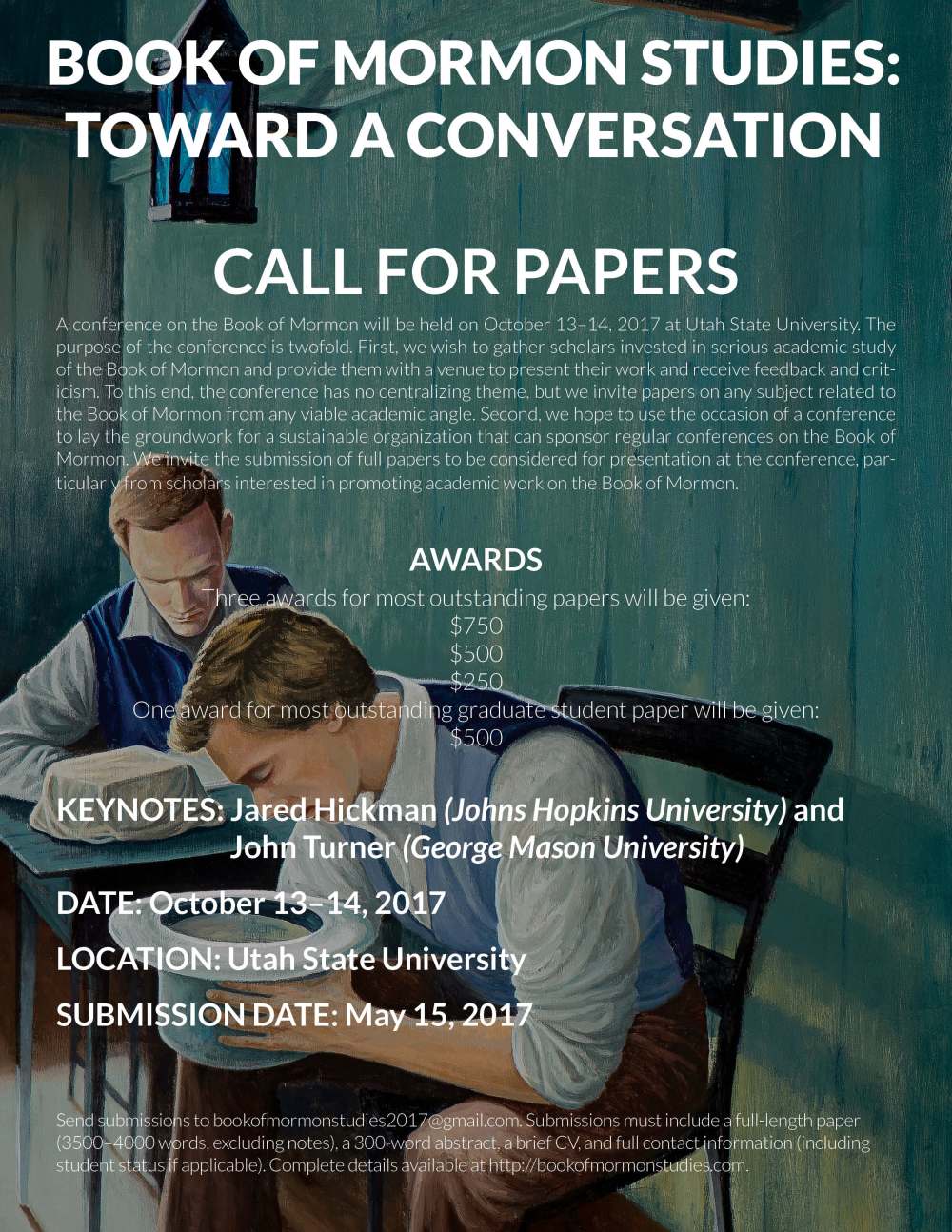
Some good friends of mine are launching a new conference and organization, so please check out the details. Here is a poster, and I’ve pasted the text from this pdf file below that.2017-bom-conference-cfp-poster-lower-res

Academic study of the Book of Mormon has never been more promising than at present. Royal Skousen’s work on producing a critical text is nearing completion, and the Joseph Smith Papers Project is making the manuscripts of the Book of Mormon widely available. Terryl Givens and Paul Gutjahr’s work has provided a basic outline on the reception history of the book. Brant Gardner has provided students of the Book of Mormon with a richly sourced and substantive commentary. Grant Hardy has introduced the content and the depth of the Book of Mormon into the larger academic world, and scholars associated with Community of Christ have recently made a case for renewed interest in the volume. The Journal of Book of Mormon Studies has begun to provide a space where various kinds of serious research on the book can be published. Book of Mormon Central has laid the foundation for a comprehensive archive of previous scholarly work. The Mormon Theology Seminar has begun assembling a body of close theological readings of specific texts. And promisingly, non-Mormon academic presses and journals have begun to publish important work on the Book of Mormon.

In the hopes of furthering all these developments, and of encouraging the pursuit of other directions, we would like to announce a conference to be held on October 13–14, 2017 at Utah State University. The purpose of the conference is twofold. First, we wish to gather

scholars invested in serious academic study of the Book of Mormon and provide them with a venue to present their work and receive feedback and criticism. Ultimately, we aim to foster a community of academics interested in the Book of Mormon. To this end, the conference has no centralizing theme, but instead invites papers on any subject related to the Book of Mormon, from any viable academic angle. Second, in gathering interested scholars, we hope to use the occasion of a conference to lay the groundwork for a sustainable (but minimal) organization that can sponsor regular (annual or biannual) conferences on the Book of Mormon. To this end, the conference will include a meeting attempting to institutionalize a regular, repeating event for gathering scholars working on the Book of Mormon.

We therefore invite the submission of full papers to be considered for presentation at the conference, particularly from scholars interested in promoting academic work on the Book of Mormon.

AWARDS

Three awards for most outstanding papers will be given:

$750 first place

$500 second place

$250 third place

One award for most outstanding graduate student paper:

$500

KEYNOTES: Jared Hickman (Johns Hopkins University) and John Turner (George Mason University)

DATE: October 13–14, 2017

LOCATION: Utah State University

SUBMISSION DATE: May 15, 2017

Send submissions to bookofmormonstudies2017@gmail.com. Submissions must include a full-length paper (3500–4000 words, excluding notes), a 300-word abstract, a brief CV (no more than two pages), and full contact information (including student status if applicable). Complete details available at http://bookofmormonstudies.com.

The Modern Mormon Athletic Image

Mormons have always held a precarious yet consistent place in America’s sports culture. Danny Ainge, Steve Young, Ty Detmer, and, most recently, Jimmer Fredette are among those have captured the nation’s popular imagination at various moments in the past four decades with their college accomplishments and, at least in the first two cases, professional success. (Still cheering for #Jimmertime success in China, of course!) The gritty workhouses of LDS communities, whose churches feature indoor basketball courts and bloody youth leagues, have produced constant competitors that seemed disproportionate to their small population. In short, Mormons know how to play ball.

Two things stand out about these figures. First, they were all funneled through Brigham Young University, the Church-owned flagship school located in overwhelmingly-Mormon town of Provo, Utah. And second, they were all white. (They are also all male, but I’ll leave the important gendered dimension for future consideration.)

Those facts themselves are central to the modern Mormon athletic image. (Or, as I’ll argue in a minute, they were until very recently.) On the basketball court, the “white dudes” at BYU are known for their three-point shooting, consummate teamwork, and hustle–you know, the facets of the game typically tethered to non-athletic white kids. As Matt Bowman has argued, these very characteristics reaffirmed classic stereotypes of the Mormon community. On the gridiron, the BYU cougars simultaneously hearken back to a classic age of pigskin orthodoxy mixed with the modern-day west-coast offense. Hunter Hampton has studied how BYU’s football program was, in some ways, an explicit vehicle through which Mormons attempted to assimilate into a particular Christian community. Of course, like most of Mormonism’s assimilation projects, they got a seat at that table only when the national mainstream left it for another. The 1984 national championship of yesterday is seen, then, as the contrarian triumph to the me-now, selfish, star-driven brand of SEC football today. What I’m emphasizing, anyway, is that the Mormon sports identity is closely aligned to their concomitantly conservative cultural identity.

With that background, let me now note the stark divergence seen in Mormonism’s three most prominent athletes today: Bryce Harper, Manti Te’o, and Jabari Parker. All three break significant cultural expectations for Mormon athletes. None of them were raised in Utah or attended BYU. Two of them are not white. One of them has made a point to speak out on progressive social issues. Together, they point to what may be the future of Mormonism’s public image.

Besides his classic “clown question, bro” retort, Bryce Harper has embodied the figure of a modern-day superstar. Though immensely talented (and immaculately sculpted), he has been accused of being selfish and temperamental by old-fashioned columnists. He is not the shy, soft-spoken, and reluctant figure typified by an LDS athlete. In many ways, Jimmer Fredette paved the way for this modern-day Mormon superstar, as outlined, again, by Matt Bowman: both athletes broke with Mormon trends of team-centered, cooperative play in favor of transcendent superstardom in the form of a Michael Jordan. This is assimilation into contemporary popular culture reflective of the post-Hinckley era. And with Harper, his professional play actually justified the hype. (But I still love you, Jimmer!) One of the hottest discussions in Major League Baseball right now is whether Harper will sign an astronomically high salary that breaks all previous precedents, or if he will become the newest high-priced and highly-acclaimed free agency savior of the pin-striped evil empire. (Ironically, it’s Harper’s contemporary rival, Mike Trout, who fits the traditional Mormon stereotypes of being quite and unassuming with a humble and workman-like persona.)

Things are more complex with Te’o and Parker, especially with the racial component. Both players made a conscious decision not to attend BYU, even though the school was amongst their finalists. (BYU students even made an, um, interesting recruiting pitch for Parker.) Te’o was one of the most decorated defensive players in recent history at Notre Dame and, after the notorious and humiliating fake girlfriend scandal (which deserves its own dissection within the Mormon context), has carved out a solid, though not yet exceptional, career with the San Diego Las Angeles Chargers. He led the team in tackles in 2015 and was voted as captain of the team the following year, but missed most of the 2016 season with injury. Of course, Te’o represents Mormonism’s long-standing Polynesian culture which has taken an increasingly prominent role in BYU’s football culture, as seen with their recruiting history, pre-game performances of the haka (which has caused some debate), as well as their recent coaching hire. They even made a video about this cultural link. If Te’o returns to stardom in the years ahead, he will help project this image nation-wide.

Raised in urban Chicago, Jabari Parker is my favorite challenge to the stereotype of Mormon athletes. He spent one year at Duke before being drafted by the Milwaukee Bucks and blossoming in his third year. Prior to succumbing to a season-ending knee injury last week (apparently another characteristic of the modern-Mormon image), he was averaging twenty points per game and considered a borderline all-star. Most importantly, Parker was the subject of an excellent Ringer profile last week that highlighted his social awakening and decision to speak out on racial issues. (It also mentioned that he only became aware of Mormonism’s racial restrictions while a college student–that must have been awkward.) If Parker continues his upward trajectory and commitment to speaking out on national issues, he’ll be a fascinating and significant figure in modern LDS culture. I, for one, have become a Bucks fan with him on the team.

It remains to be seen how much of an impact these athletes will have in Mormon, sports, and American society. But I think they represent an undeniable shift. One of the next big Mormon athletes, Frank Jackson, is another African American basketball player who is following Parker’s route through Duke. (Though he attended High School in Utah County, most of Jackson’s upbringing was in the DC area.) Even BYU’s football team has adopted a more diverse image, as football coach Kalani Sitake has infused the program with much-needed pep. (And as they try to recover from a checkered racial past.) Just check out their team hype video from the last year, which would have been unthinkable in previous generations:

This isn’t your grandfather’s BYU.

As the Mormon faith and community moves to adopt a more diverse image, it makes sense that athletes would lead the way. Sports has long been a venue for cultural transformation within the LDS tradition. Following the careers of these current athletic stars, then, offers insights into the overall trajectory of the church they happen to represent.