Review: Brent Rogers, UNPOPULAR SOVEREIGNTY

A hard confession from someone who specializes in the early republic and antebellum periods: the 1850s is my favorite decade to teach in the American survey. It always feels like my lectures are a sprint throughout he semester, given the nature of the course, but it still seems to pick up speed once we hit the Compromise of 1850, and we don’t get another breather until The corrupt bargain of 1877. (I can never skimp on Reconstruction, especially given today’s circumstances.) I say this is a hard confession because my own research ends in the 1840s, so you’d think I’d prefer the weeks that precede these lectures. But there’s something about the 1850s that really captures me.

Unpopular Sovereignty: Mormons and the Federal Management of Early Utah Territory (University of Nebraska Press, 2017), Brent Rogers’s new book, helped me finally put my finger on what it is about the decade that grabs my attention: the sheer audacity of imperial desires, the violent results of local implementation, and the juxtaposition of sophisticated political theories and parochial hypocrisies dominated the American landscape. These tensions had been around since the beginning, of course, but they were brought to the foreground as soon as the nation finally possessed a continent-wide empire. It is ironically tragic, of course, that the fulfillment of that long-held dream was what cemented the Union’s (temporary) dissolution.

Utah Territory in 1850 was part of a large swath of land theoretically governed by the federal government. In reality, though, the area west of the organized states was an arena for racial, political, and provincial squabbles. This was no small region under the careful thumb of Uncle Sam: the square mileage of the territories outnumbered that of states. America was finally an empire, but one that was spread razer-thin. Determining how to colonize, organize, and integrate this region was of national significance. Historians of early Utah have often emphasized the tense relations between LDS leaders and national politicians, but few have adequately contextualized the episode within this much broader question of federal governance in an era of over-expansion. Rogers’s book exhaustively overviews the political interplay between the Mormon people, with their theocratic ideas and people spread across the Rocky Mountain region, and the Washington DC leaders, who tried to corral their renegade zealots even as they simultaneously attempted to hold their nation together.

Central to these 1850s debates was the idea of popular sovereignty. Most know the concept from its most prominent proponent, the “little giant” Stephen A Douglas. Basically, it was the belief that these western territories should be able to determine their own fate rather than rely on federal intervention. The issue most relevant to this concept, of course, was slavery. How should the nation decide which new states carved from the expansive western area would be slave or free? Douglas proclaimed that the federal government had no business solving this question at all. He worked to pass the Kansas-Nebraska Act, which overturned previous congressional ruling regarding the fate of slavery in those territories. Students in my survey courses become well aware of Douglas’s popular sovereignty philosophy when we dissect his famous debates with Abraham Lincoln. I’m sure this is quite common in classrooms throughout the nation.

So what does Mormonism have to do with popular sovereignty? Rogers argues that, like Kansas, Utah “emerged as a key battleground and hotbed of antebellum debate over popular sovereignty” (3). If western territories should be granted the autonomy to govern themselves, what about the Mormons? Federal dealings with Utah proved that popular sovereignty was not a monolithic one-size-fits-all philosophy. The strength of Unpopular Sovereignty is found in Rogers’s exhaustive overview of competing ideas concerning democratic governance in the West. The federal government was surprisingly adaptive. At the heart of the issue was a question of civilization: Who could be trusted to govern themselves? Southern slaveholders? Mormon polygamists? Native tribes? These three groups, along with others, were found on a spectrum of political philosophies that were never full comprehensive nor coherent.

I wish Rogers would have spent a bit more time on the racialization of popular sovereignty and democratic governance. He does have a chapter on the relationship between the Mormons and their Indian neighbors, both the real connections as those imagined in Washington, but he mostly dealt with them as political bodies. Popular sovereignty, I’d argue, was built upon ethnic conceptions of belonging and nationhood. Paul Reeve’s recent book highlights this, but the political dimensions of this angle should still be unpacked. The place of racial minorities was a crucial topic for the American nation at the time, especially with the newly-acquired land from Mexico, and Mormons played into that debate as well. Whiteness and American westward imperialism still needs more work. That’s likely too much to ask for an already hefty tome that has dug so deeply into other topics, however.

Rogers makes several key historiographic interventions, both in political and Mormon spheres. His work on the plurality of popular sovereignty adds to a lively discussion on what was previously a staid topic. His comparative work on Kansas and Utah also demonstrates the fraught nature of democratic experiments in the 1850, proving that popular sovereignty was contested even within the Democratic Party. And his argument that the Utah War in 1857-58 set the stage for nation schism (Southerners saw it as a challenge to local sovereignty, and Republicans used it as evidence for the Democrats’ hypocrisy) contributes an intriguing nuance to a crowded narrative. Historians of American politics will learn a lot about the vagaries of democratic discourse, and teachers should have new material to share in the classroom.

And what about the Mormon historiographic sphere? For starters, Rogers demonstrates one way to overcome the “donut hole” problem of western history. (That traditional narratives of the American West circle around Utah but never really integrate the state and its Mormon residents.) The Mormon clashes with federal government in the 1850s was not completely unique, but rather part of a much larger moment of imperial expansion and related to questions concerning federal governance. And Rogers’s focus on the multiplicity of opinions on either side of the divide—neither the Mormons or their opponents were ever notably consistent—breaks down the tired bifurcated narrative of saints vs. gentiles. His is a model of integration and nuance.

The book became quite long and meticulous at times—perhaps like this review?—but overall I found it quite compelling. It interweaves published and private writing, not to mention useful maps, into a grand story of federal conflict. I hope it is a sign of more scholarship that better situates Mormonsim into America’s quixotic history of democracy.
Review: Eric Hinderaker, BOSTON’S MASSACRE

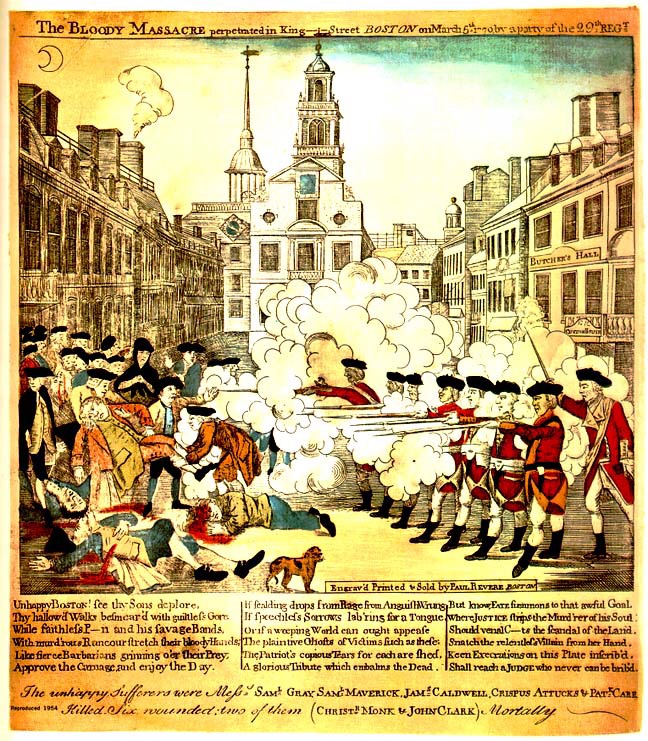
The Boston Massacre has loomed large in America’s historical memory. Taking place five years before the battles at Lexington and Concord, the episode featured British soldiers firing into a gathering of unarmed colonists. Four died on the scene, and another succumbed to mortal wounds a few days later. The moment and its martyrs were immortalized in a famous Paul Revere illustration that same year:


But the story has complex legacies. Was this a significant step on the way to rebellion and independence, or was it the result of an unruly mob? Those who watched the HBO series John Adams might have been surprised that Adams defended the British soldiers. He argued that they were being cornered, bullied, and pelted with snow and ice by the cities miscreants. They were hooligans, in other words. Those actually protesting British rule, Adams claimed, were much more orderly. His argument was successful, as they were all acquitted.

But that does not mean the “massacre”—a term that is itself a politicized description, just like Adams’s use of “mob”—does not reveal a lot about the coming of the American Revolution. Eric Hinderaker’s new book, Boston’s Massacre (Harvard UP) uses the episode to tell a much larger story. Besides giving an exhaustive overview of the events that transpired on March 5, 1770, including extensive details concerning the city and its governing structure, Hinderaker explores the world that led to it as well as the multiple worlds it created. This story is both explicitly intimate—when learning about all the various people who played leading roles in the story, I was reminded of how small and parochial Boston really was—as well as exceptionally broad, as it situated Boston within an immense and evolving British empire.

The first half of the book is a series of thematic chapters focused on different lenses through which to see the massacre’s origins. For example, one chapter discusses changing beliefs concerning a standing militia within Britain and her colonies, and another details how resistance efforts operated in the half-decade following the Stamp Tax ordeal. The Massachusetts colony was a proud participant in the effort to build Boston as an imperial space, and only came to regret it when that very power was turned against against their residents. The story of Britain in the mid-eighteenth century is the birth of a militant power. When the empire won broad new swaths of land from France, it inherited dozens of forts and thousands of miles that had to be guarded. This required a radical expansion of the standing army. Those in the colonies were not used to these new circumstances and often fought back. Hinderaker’s analysis usefully interweaves comparative examples to help understand the Boston experience, including those inside Britain (Ireland) as well as outside (Spanish New Orleans). I learned quite a bit concerning how imperial militias were governed, moved, and housed in the early-modern period.

And then there’s the massacre itself. The most striking detail about Hinderaker’s account is how up-front he is concerning how little we know about it. He digs through particular interviews, trial notes, prosecution and defense arguments, as well as propaganda, and concludes that nearly all of it is clouded by agendas. Did the captain instruct the soldiers to fire? Were there more shooters on the second floor of the customs house? While Hinderaker explores these questions and provides exquisite detail, he concludes that much of the event will remain a mystery. What is clear, though, is the surrounding circumstances: Boston had become a crowded city with unwanted soldiers housed in makeshift barracks and gunning for the locals’ jobs. At the very least, they were an affront to the city’s character. The massacre was the culmination of imperial conflict. But some in the town also saw the mob violence that led to the shooting as equally contemptible. In defending the soldiers, John Adams and his fellow lawyers sought to save their city’s reputation by blaming it on the neighborhood’s miscreants; most notably, he played up the role of Crispus Attucks, a slave of Native and African American descent, who Adams differentiated from the calm, reasonable, and collected patriots of Boston.

The book takes a different approach once the trials are concluded. The final chapters focus on how the meanings of the massacre evolved over time. Hinderaker persuasively demonstrates that the event drew little attention outside of New England—or even Boston, for that matter—for quite some time. But it certainly became part of the city’s consciousness during the Revolution. Annual lectures commemorated March 5 for a decade, and speakers highlighted British tyranny and colonial innocence. But the event’s importance subsided after the conflict’s conclusion in 1783. From that point on it was a point of ambivalence. Highlighting it did indeed cement Boston’s role in the revolutionary struggle, but it also opened them up to accusations of lawlessness. This anxiety has persisted ever since, and has been present at every moment of resurgent memory.

But that did not keep different groups from appropriating the event as their own. Some were unexpected, like when abolitionists in the 1850s played up the role of Crispus Attucks as a martyr for America’s origins. (Remember: John Adams used Attucks as an unruly scapegoat to preserve Boston’s responsible character; that his words were later use to make Attucks a hero demonstrates the malleability of memory.) Then, in the twentieth century, when Americans worried about the rise of a military state, the massacre was once again dusted off and displayed. Memories of 1770 Boston resurfaced with debates ranging from the Kent State shootings in 1970 to Michael Brown in the Age of #BlackLivesMatter. I’m sure the story will still be used in similarly innovative and significant ways in the future.

As you can tell, Boston’s Massacre is a sprawling narrative. As a result, there are times when it didn’t seem to hold together, as the individual parts were more coherent than the whole. Since the chapters were thematic and danced around the event, rather than taking a strict chronological development toward and away from it, there were portions that seemed redundant. Particular chapters jumped forward and backward in ways that could appear confusing. The text sometimes reads better as a collection of essays. In a way, that kaleidascope structure reflects the massacre itself, as the angle through which one chooses to look largely determines the picture that you see. This is an excellent historical meditation on a crucial story—not to mention the historical craft. I look forward to assigning portions of it in class.

Review: Spencer McBride, PULPIT & NATION

If the mark of a good book is it provides lots of intriguing material, fascinating characters, and much to debate, then Spencer McBride’s Pulpit & Nation: Clergymen and the Politics of Revolutionary America (University of Virginia Press, 2017) is a good book. In an age where the traditional trajectories of religion and politics seem in transition, McBride tells us that the unholy alliance between ministers and elections is nothing new. Indeed, this tension has existed from the very founding. Yet it is not a simple story you might assume. “Christian America” was not so much the result of religious ideals driving state formation as it was a partisan tool invoked in particular circumstances. It was left for later generations to misread these prescriptive proclamations as descriptive records. Reconstructing this ambivalence and complexity–especially the role played by ministers themselves–is the focus of this book.

A constant theme throughout the book is clergymen’s ability to capitalize on political opportunities. At the commencement of the American Revolution, ministers recognized their chance to buttress their own cultural authority and societal standing by serving as “essential intermediaries” between national politicians and local congregations (2). This was a reciprocal relationship: clergymen were able to give meaning to a national struggle within their parochial settings, and in return they received political capital. So while religious ideas did not play a role in these developments–he emphasizes that the Revolution “was not a religious event” (4)–the battle’s success depended on how clerical leaders aided the cause. Fast Days, in which patriotic and liturgical events merged, were an especially poignant example of this dynamic. Mobilizing chaplains served as a symbolic validation of the revolutionary movement. Ministers rallied the troops, strengthened allegiances, and prepared soldiers for death. But most importantly, they kept the soldiers in the war. Clergymen simultaneously validated the war while also being validated by their participation.

Pulpit & Nation zooms both in and out throughout its chapters. Portions of the text focus on broad narratives and larger themes, but others zero in on individuals. I was especially taken by the chapter that focused on three clergymen in order to demonstrate how political allegiance was complex and layered. The Connecticut loyalist Samuel Seabury, recently made famous by his dandy portrayal in Hamilton, was able to weather the attacks on his non-patriotic leanings and actually become a powerful religious figure after the Revolution. Virginia Revolutionary James Madison–cousin to the President of the same name, was the only radical on William and Mary’s faculty, and therefore was quickly catapulted to high leadership. And John Joachim Zubly, a Swiss minister in Savanah, tried to remain neutral but died destitute and despised. Each of these cases exemplified the incongruous routes that clerical and political affiliations emerged.

Later chapters cover the role of ministers in debates over the Constitution, the rise of the two-party system, and Thomas Jefferson’s presidential run. In each case, local circumstances dictated ministerial participation much more than religious belief. “To understand how and why American clergymen preached party from their pulpits,” McBride explains, “it is essential that we understand the challenges they were facing in different localities” (128). In Massachusetts, liberal and conservative ministers could team up to confront the threat of Jacobins; in Massachusetts, Evangelicals and “liberal rationalists” could work together to overcome establishmentarianism. Even when addressing Jefferson’s deism, threats of heresy “had as much to do with the ballot box as it did with the nation’s ‘soul'” (149). Religion has always been a potent tool.

In McBride’s work, religion is everywhere and nowhere during the revolutionary era. Everywhere, because it provided the symbols and language that gave the action meaning; but nowhere, because it lacked instigative force. This is a clever historiographical play, because it allows him to critique both those who downplay religion’s precede as well as those who overstate its centrality. It also establishes a much more ecumenical framework for America’s religious past: people of different faiths can work together for religious and political causes despite theological differences. That’s why Fast Day rituals work so well, because even the deist Jefferson could support them. And Madison, for another example, believed independence was God’s will, “but it was his rational and philosophical observations of the crisis in the early 1770s, and not his religious beliefs, that convinced him to support the patriot cause” (89). This is a broad umbrella for inclusive participation.

But I’m not sure this neutered form of political theology is much of an improvement upon traditionally secular narratives. Can religion only serve as a powerful force when deprived of its mental contribution? Can belief shape political action and ideas, rather than merely be shaped by them? I can certainly get behind McBride’s pragmatic religionists, but I still wonder whether we are casting them in the image of our contemporary and secular world.

To play the role of provocateur, I’m not willing to concede that religious ideas weren’t as crucial as political realities. It’s all well and good to say that the myth of an American nation “arose from the calculated efforts of parties and politicians and their clerical allies during the fractious struggle for power in the decades immediately following independence,” but is that the full extent of the relationship? Couldn’t religious ideas have shaped the very understanding of nation to begin with?

These are questions outside the scope of McBride’s work, so it is unfair to critique him too hard with them. But if useful monographs are meant to raise as many issues as they do answer them, Pulpit & Nation does the job. As Americans re-imagine the role of religion in electoral politics over the next decade, this is a text that could serve as an important primer.

Review: Richard Van Wagoner, NATURAL BORN SEER

Prior to his untimely death, Richard S. Van Wagoner was a prolific and respected amateur historian of the LDS faith. Besides an excellent biography of Sidney Rigdon, he also authored a well-received history of Mormon polygamy. It was therefore justified when the Smith-Pettit Foundation tapped him to write the first of a three-part biography of Joseph Smith. Though the entire series never appeared as the originally-conceived trilogy, two of the volumes appeared last year. Martha Bradley-Evans authored the Nauvoo-era biography, which I reviewed here. And now Van Wagoner’s volume, Natural Born Seer: Joseph Smith, American Prophet, 1805-1830, which covers the Prophet’s first 25 years, is also available for perusal. This is a meticulously researched, thoroughly argued, and and impressively written resource for scholars of Early Mormonism, and a helpful repository of scholarship from the New Mormon History era.

Natural Born Seer, due to its purpose and scope, shares many of the strengths of Bradley-Evans’s sister volume. The length and depth allows the author to dig into issue and events in ways that are typically glanced over in broader volumes. But the occasional reliance on problematic sources, including Lucy Mack Smith’s memoirs and, to a lesser degree, History of the Church, at times causes problems. Thankfully, Van Wagoner buttresses HoC sources with other primary material, many of which was new to me. Truly the book stands on the shoulders of decades of archival workers like Dan Vogel and Michael Quinn. The book will be an essential crutch for scholars of Mormon history for quite some time.

Perhaps one of the most useful accomplishments of the book is it collates and summarizes an entire generation of New Mormon History scholarship. Work on treasure seeking, the Book of Mormon, Smith family dynamics–even if Natural Born Seer doesn’t provide much novelty, it makes up for it in exhaustiveness. It will be imminently convenient to keep this book at arm’s length for a quick resource when needed. However, there are some limits to this secondary literature. Most of the books Van Wagoner cites for Smith’s cultural context are a few decades old, and therefore the book misses out on some of the most recent historiogrpahical trends in American frontier, folklore, and religious history. So even from this angle, Natural Born Seer is reflective of an earlier age.

The major problem facing any biographer of Joseph Smith’s early life is the lack of contemporary sources and the proliferation of later reminiscences. Van Wagoner takes an interesting approach to solve the issue. On the one hand, he sets out to privilege the earliest material; however, he doesn’t shy away from using later developments to shape what he believed were central character traits. And one of the primary Smithian features, according to Van Wagoner, was deception. So while he insists that The Peophet’s life was not “dominated by deception,” he still insists that “it is an important trait–one of many that define his character and personality. Ignoring the prophet’s duplicitous self will result in a failure to understand the man” (xiv). The introduction even goes so far as to share a number of anecdotes of Smith lying during the Nauvoo period in order to frame key questions of the narrative, since he believes it reveals Smith’s deeper character. Such is a fair and justifiable decision. But it does bring consequences. There are moments, especially related to majors events in LDS sacred history, that become politicized. Smith’s First Vision, for instance, is treated more as a later creation than a contemporary moment. Van Wagoner claims that Smith was much more interested in treasure seeking than religious visions in 1820 (186-188), implying the two things could not exist simultaneously. Such a dichotomous framework, of course, was Smith’s own later construction. The older Smith claimed a distinction between divinity and folklore, but did the younger Smith feel similarly?

One episode in this volume epitomizes these larger tensions of the entire book: the chapter on Joseph Smith’s leg surgery as a kid. On the one hand, Van Wagoner unearths the lecture notes, private and public writings, and student reminiscences related to Nathan Smith, the Dartmouth surgeon who performed the operation. That was excellent detective work, and revelations like that sprinkled throughout the text justify the volume on their own. But Van Wagoner also heavily (and uncritically) relies on Lucy Mack’s memoir to reconstruct the family psyche. So it’s a careful and tedious reconstruction of the nuts and bolts of contemporary medicine while still couched in the narrative of Lucy’s triumphant tale. And further, for secondary sources Van Wagoner overlooks recent scholarship on medicine and folk culture in favor of dated psychoanalysis. Thus the mix of useful and frustrating detail.

I don’t want these critiques to take away from my praise. Van Wagoner was a careful historian whose work deserves acclaim. This book is a fitting culmination for a career cut too short. And even more than exhaustive detail, I found the writing–save for an unfortunate reliance on block quotes–to be exceptional. Would that all Mormon history books featured this prose.

I’m going to close this review with a discussion of audience. Who was this book written for? Due to its meticulous detail and parochial scope, not to mention frequent and sometimes unexplained references to later episodes in Smith’s life, Natural Born Seer probably won’t find many readers amongst those unfamiliar with LDS history. And because it does not really engage current academic questions, it likely won’t catch the eyes of the non-Mormon scholarly community. But that’s okay, because I’d argue this book wasn’t designed for these people. Rather, this book is written for Mormon readers who, after reading classics in the field, are ready to make a deeper dive into Joseph Smith’s life. This is the Mormon history book for the Mormon history nerds. And because of that–because it carries certain assumptions concerning its audience–it can dig deeper than other volumes.
For those anxious for a deeper look into Joseph Smith’s origins story, Natural Born Seer is an exceptionally useful resource.

Review: William Mackinnon, AT SWORD’S POINT, PART II

For such a small chronological scope, William MacKinnon’s documentary history of the Utah War covers a lot of ground. Though the armed confrontation in 1857-1858 was theoretically isolated to the Rocky Mountains, its tentacles touched far and wide.  Soldiers were sent as far south as New Mexico to purchase supplies. Facing the threat of another Mormon relocation, the British government set to fortify their Pacific lands. Fearing an invasion, the Russian Tsar sought to sell the territory of Alaska. California appeared as both a boundary and a revolving door for either side of the conflict. And at the center of it all was American President James Buchanan, Mormon Prophet Brigham Young, and the very stakes of federal sovereignty in a country ready to go to war. This was no small, insignificant, nor parochial skirmish.

Scholars of Mormon history have been long anticipating the release of the second volume of MacKinnon’s At Swords Point: A Documentary History of the Utah War, 1857-1857, part of the heralded “Kingdom in the West” series. The first volume, which covered events in 1857, was published in 2008. And now the second volume, focused on 1858, finally appeared last year. It was worth the wait. Like its predecessor, the book is a collection of crucial primary sources sandwiched between substantive background and annotation. The result is a mix between sourcebook and monograph, as it is structured as much to tell a story as it is to introduce you to key documents. At Sword’s Point is a crucial contribution to the fields of Utah, Mormon, and military history.

Volume One left off just as Albert Sidney Johnston’s army arrived at the Rocky Mountains as winter set in. What followed were months of anxiety, preparations, and cold weather. Strategies, or at least semblances of strategies, were cultivated on either side of the mountainous terrain, even as leaders pursued new possibilities of a peaceful resolution. Thomas L. Kane, among others, played a key role in making sure cooler sides prevailed. So even though Young ordered the Saints to flee south and leave Salt Lake City abandoned–several powerful accounts of which are included in this volume–when the US army finally marched in the Mormon Mecca it was under the flag of truce. But that was far from a predetermined conclusion. As At Sword’s Point demonstrates, the confrontation could have gone many ways at many different times.

Though the general contours of this conflict may be well known, readers will find loads of new material. This is a historian’s history. MacKinnon digs deeper than nearly any other book I’ve encountered, monograph or documentary, and he knows more about the Utah War than most historians know about their personal pet topic. The book drips of the perspiration from decades of labor. But while the field of military history is known for dense and meticulous archival work, At Sword’s Point clears that barrier with room to spare. Though a documentary history, the story flows smoothly and it’s lessons are clear. It is a true skill to be able to tell a story with powerful meaning through documentary editing. This is one of the few volumes that accomplishes such a fete.

That said, casual readers may have trouble making it all the way through. The book might serve better as a resource for further research than a narrative history. But that’s just fine, as it is work like this that lays the foundation for future projects more directed at a public audience. And in the scholarly world, At Sword’s Point will serve many purposes. Western historians will be interested in the process of colonizing western lands beyond Utah, including New Mexico and Colorado. Military historians will be intrigued with these on-the-ground accounts of everyday soldier life. Political historians will find value in the debates over sovereignty and diplomacy. And Mormon historians will of course be rewarded with new insights into one of the Church’s most significant episodes. (They will also enjoy cameo appearances from figures like John C. Bennett and William Smith.)

The one portion that I wish everyone could get their hands on is the book’s concluding essay. After spending forty years in the wilderness of Utah War material, MacKinnon’s summative thoughts are those of a seasoned expert. Though only about twenty pages, the essay which surveys all the nuances, issues, and historiography of the confrontation is worth the price of admission on its own. In it, MacKinnon is not in the business of casting good guys and bad guys–either titling the war “Buchanan’s Blunder” or casting Brigham Young as a ruthless villain–but he is clear in assigning plenty of blame. Young was absolutely at fault for creating a hostile environment for ten years that challenged federal authority, and the decision to remove him from territorial office was justified. But Buchanan went about the replacement all wrong and enflamed things when he could have cooled them down. Then Brigham, in turn, escalated the conflict into a rebellion–a term that MacKinnon uses carefully. Even philanthropic figures like Thomas L. Kane are seen as enablers whose assistance is genuinely questioned. If readers are hoping to find one victorious side in this conflict, they will be disappointed.

But that is what makes this a useful volume. The 1850s were a turbulent time in America, as questions over federal, state, and territorial sovereignty drove national conversation. It should not be surprising that these questions–rather than mere debates between Saints and Gentiles–were at the heart of the Utah War conflict. Previous historians localized the episode and made it a Mormon/non-Mormon affair; MacKinnon is wise to zoom out and take a wider picture. Only then can we fully understand the significance of a sectional battle on the eve of the Civil War.