Classes and Syllabi, Spring 2018

Things have been quiet around here as the last few weeks have been a blur. But now that the semester has commenced I hope to return to a more standard schedule, including my Wednesday book reviews.

I’m excited for the Spring semester to finally start, although it was postponed again this week as a surprise freeze gripped the region. For those interested, here are the three classes I’m teaching this semester. As you can tell, I’m all Revolution, all the time. The Hamilton musical is coming to Houston in a few months, so I’m taking advantage of the cultural excitement that comes with it. (The titles link to the syllabus for the course.)

And by the way, in case you missed the news, my book is out! I’ll have more info next week.

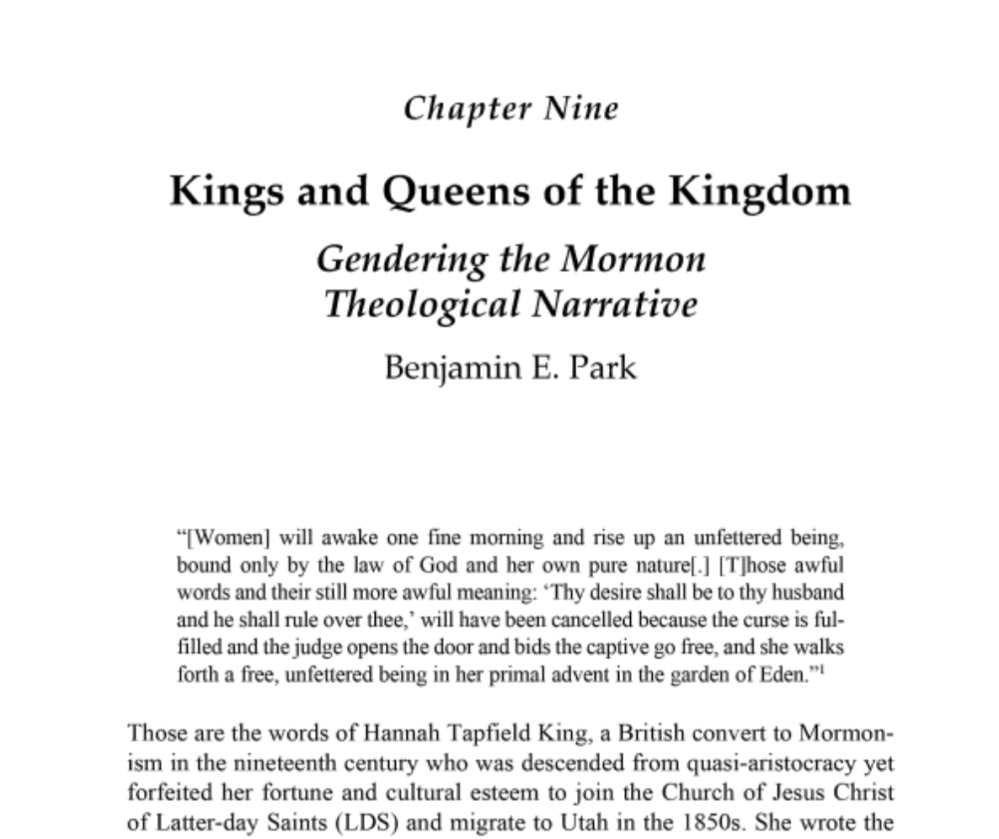
New Article: “Kings and Queens of the Kingdom: Gendering the Mormon Theological Narrative”

A few days before I left Texas for the holiday break, I received a copy of a new edited volume: Mormon Women’s History: Beyond Biography, edited by Rachel Cope, Amy Easton-Flake, Keith Erekson, and Lisa Olsen Tait. The volume began with a conference held at BYU and Salt Lake City a couple years ago that tried to explore what happens when Mormon women’s history left the safe confines of biography—a methodological safeguard that had been common in the field. There are a lot of great gems in the collection. Here is the table of contents:

Introduction vii
Rachel Cope
1 Charting the Past and Future of Mormon Women’s History
Keith A. Erekson
2 Sifting Truth from Legend: Evaluating Sources for American Indian Biography through the Life of Sally Exervier Ward
Jenny Hale Pulsipher
3 Silent Memories of Missouri: Mormon Women and Men and Sexual Assault in Group Memory and Religious Identity
Andrea G. Radke-Moss
4 Early Mormonism’s Expansive Family and the Browett Women
Amy Harris
5 Poetry in the Woman’s Exponent: Constructing Self and Society
Amy Easton-Flake
6 Aesthetic Evangelism, Artistic Sisterhood, and the Gospel of Beauty: Mormon Women Artists at Home and Abroad, circa 1890–1920
Heather Belnap Jensen
7 Leah Dunford Witdsoe, Alice Merrill Horne, and the Sacralization of Artistic Taste in Mormon Homes, circa 1900
Josh E. Probert
8 Double Jeopardy in Pleasant Grove: The Gendered and Cultural Challenges of Being a Danish Mormon Missionary Grass Widow in Territorial Utah
Julie K. Allen
9 Kings and Queens of the Kingdom: Gendering the Mormon Theological Narrative
Benjamin E. Park
10 Individual Lives, Broader Contexts: Mormon Women’s Studies and the Refashioning of American History and Historiography
R. Marie Griffith

While each of these are worth a read, I particularly loved Andrea Radke-Moss’s careful meditation on the use of historical sources in order to engage rape accounts from the Mormon-Missouri War. It’s an article that should make waves in the Mormon history field.

Screen Shot 2018-01-02 at 9.04.20 AM

My chapter is part-extension of my Nauvoo project and part-exploration of gendered methodologies. I argue that the historiography on Mormon thought has been divided into two spheres: “Mormon theology,” which is primarily men, and “Mormon women’s theology,” which is sequestered into its own space. Here are two paragraphs from the introduction:

This compartmentalization is representative not only of the field of Mormon history but also the general approach to historical theology. That is, even while the subfield of women’s history is encouraged, it is often compartmentalized from broader Mormon narratives and frameworks. What Paul Harvey and Kevin Schultz said about religion within twentieth-century American history can similarly be said about women in Mormon history, and especially Mormon historical theology: it is “everywhere” in that specialized work in the field has proliferated at an astounding rate, but it is still “nowhere” in that it has been relegated as marginal and contained.5 Women’s history becomes a methodological ghetto, unable to make any real revision to synthetic narratives. Only through the integration into broader synthetic stories can our historical narratives become less exclusive and more representative. Otherwise, only those specifically interested in women’s history will encounter the lessons of the subfield.

This chapter is both historiographical and provocative in nature and seeks to point to future roads for historians to traverse and questions for scholars to answer. Following a general overview of how historians of Mormon thought have dealt with—or, in many cases, avoided dealing with—theology produced by women, it will posit reasons for this androcentric framing as well as point toward potential methodological avenues for more integrative synthetic approaches. Rather than merely carving space for the history of women in Mormon thought, we must conceive of ways in which female voices both constructed and transformed the history itself. And finally, this chapter will offer one example of such a study that seeks to blend both male and female voices into a Mormon theological narrative of the Nauvoo period. Throughout, this chapter also attempts to demonstrate how this Mormon example provides important lessons for theological, intellectual, and religious history more broadly, as it identifies how to integrate a broader array of voices and frameworks into broader synthetic narratives.

Sadly, Farleigh Dickinson University Press’s pricing model makes the volume cost prohibitive. I wish it were otherwise. But pester your local library to purchase a copy, because there are several great chapters in this volume.

Things I wrote in 2017

Continuing a tradition from last year, this is my attempt to categorize everything I wrote in the last twelve months. It’s been a good year!

Articles:

  • “The Bonds of Union: Benjamin Rush, Noah Webster, and Defining the Nation in the Early Republic,” Early American Studies 15:2 (Spring 2017): 382-408.
  • “The Angel of Nullification: Imagining Disunion in an Era Before Secession,” Journal of the Early Republic 37:3 (Fall 2017): 507-536.

Chapters/Essays:

Op-Eds

  • “Mormon Tabernacle Choir Will Usher in the Trump Era,” Religion Dispatches (January 20, 2017).
  • “Where is the Mormon Church on Trump? History Demands their Leadership,” Washington Post (January 28, 2017).
  • “The Democratic Lineage of Trump’s Ethnic Nationalism,” Starting Points (April 13, 2017).
  • “Why It’s Time for the Mormon Church to Revisit its Diverse Past,” The Conversation/Newsweek (April 22, 2017).
  • “How Funding for the Humanities Helps Public College Students Become Better Texans,” Dallas Morning News (August 3, 2017).
  • “Mormons and the Boy Scouts: Heading Down Different Trails,” Religion News Service/Salt Lake Tribune (October 17, 2017).

Published Book Reviews

  • Review of Mark A. Lause, Free Spirits: Spiritualism, Republicanism, and Radicalism in the Civil War Era (Urbana: University of Illinois Press), Civil War Monitor (2017).
  • Review of John Bicknell, America 1844: Religious Fervor, Westward Expansion, and the Presidential Election that Transformed the Nation (Chicago: Chicago Review Press), BYU Studies Quarterly (2017).
  • Review of Laurel Thatcher Ulrich, A House Full of Females: Plural Marriage and Women’s Rights in Early Mormonism, 1835-1870 (New York: Knopf), Dialogue: A Journal of Mormon Thought (2017).

Media Interviews/Quotes

  • Max Mueller, “Not My Choir: By Agreeing to Sing at Trump’s Inauguration, The Mormon Tabernacle Choic has Enraged Many Mormons and Forced a Reckoning Over the LDS Church’s Values,” Slate (January 19).
  • Claire Provost, “Building Zion: The Controversial Plan for a Mormon-Inspired City in Vermont,” The Guardian (January 31).
  • Noémie Taylor-Rosner, “Fausses nouvelles, un phénomène aux ancrages chrétiens,” Presence (March 8).
  • Sadie Bergen, “From Personal to Professional: Collaborative History Blogs Go Mainstream,” Perspectives on History (April).

Consultant on Public History Projects

  1. Amici curie filed with the Supreme Court opposing President Donald Trump’s immigration ban. The brief was covered in CNN, Washington Post, Huffington Post, and several other newspapers.
  2. Reference booklet, “Shoulder to the Wheel: Latter-day Saints Working to End Racism and Become a Zion People.” Has been downloaded more than 1000 times.

Commentary Blog Posts

Historical Blog Posts Based on Nauvoo Project

Blog Post Book Reviews

Historiographical Posts

Year-in-Review Lists

Review: Moss and Baden, BIBLE NATION

Within a few minutes’ walk from the United States Capital in Washington DC, a visitor might stumble upon an impressive eight-story structure dedicated to “reacquaint[ing] the world with the book that helped make it.” The Museum of the Bible opened just last month after several years of anticipation. In some ways, it is similar to other recent Evangelical enterprises, like the Ark Encounter in Kentucky, which seeks to guide Americans back to their biblical roots and avoid the secular perils of modernity. Yet it is also somewhat unique: it frames itself as a non-sectarian establishment focused on merely presenting the “facts” of the Bible. But as Candida Moss and Joel Baden outline in their new and riveting book, Bible Nation: The United States of Hobby Lobby (Princeton UP), this is merely the latest step in one wealthy family’s attempt to help America become a “Bible Nation.”

Most Americans know the David Green family for two things: their ownership of Hobby Lobby, and their Supreme Court victory over Obamacare, the latter of which allowed them to refuse contraceptive medicine to their employees. They might also be known for their devoted evangelical and philanthropic initiatives, including Steve Green’s founding of the Museum of the Bible. But many were surprised when the Greens were in the news a few months ago after federal prosecutors accused them of illegally importing 5,500 ancient artifacts. But you know who wasn’t surprised? Moss and Baden have been breaking news on the story for several years. Indeed, their Bible Nation is the result of several years of research into the Green Family’s Bible project, an endeavor that not only includes a museum but also an extensive amateur archival collection, robust scholarship initiative, and earnest curriculum proposals.

Each of the four chapters in the volume focus on one of these aspects. The first chapter dives into the world of artifact sales, an arena filled with strict laws, legal loopholes, and shady deals. When the Greens decided to enter the artifact game, they hired a series of collectors to act on their behalf. Many of the earliest purchases—they eventually came to acquire around 40,000(!) artifacts—had murky backstories and sketchy provenances. (The cuniform tablets that got the Greens in trouble were bought during this period.) Moss and Baden skillfully demonstrate how these activities affected the broader market, implications of which we are still dealing with today. The Greens, the authors explain, seem to “underestimate the degree to which provenance matters, and the real-world ramifications of the illicit antiquities trade” (44). The actions of reckless buyers and sellers jeopardizes real-world conditions, especially in the Middle East.

But what do they do with the material once they are collected? The Green Scholars Initiative (GSI) is a program in which the foundation chose academics—often at religious schools, and nearly always with little background in papyrus scholarship—to work on individual projects, along with student researchers. The theoretical goal was to produce published volumes in which ancient papyri are translated, transcribed, and introduced. While senior scholars would serve as mentors—and the list of GSI mentors became quite impressive—most of the work was done by people with little training in the field. The results were mixed. Nearly all who participated, including the students, were forced to sign non-disclosure agreements, which allowed the GSI to control the information stemming from the various projects. (While a common practice in the business world, it is unheard of in academia.) Moss and Baden hypothesize that those documents or ideas that would challenge traditional evangelical narratives were sequestered. The main story the Greens wish to prove is the Bible’s consistency and supremacy, and any challenges to that story gets relegated to the background.

There was a financial aspect to the Green’s archival collection and scholarly initiatives, and Bible Nation carefully spells out a potentially materialistic explanation for the whole initiative. When the Greens’ representatives originally purchased the artifacts, they were often relatively cheap due to an artificially controlled market and the items’ sketchy provenance. Yet by putting the materials through the rigors of scholarly analysis improves their relevance and increases their monetary value. The Greens could then get the documents newly appraised and then donate them to a non-profit organization—namely, their own Museum of the Bible. Whatever value the donated document, which is often far greater than the original purchase price, can now be used as a tax deduction. Through interviews, Moss and Baden were able to trace how the Greens expected to get a particular monetary reward over the years in order to assure a financial gain.

This places scholars in a difficult predicament. Research in the Green collections risks validating their questionable purchase history, a modern-day act of colonialism that the federal government is still trying to investigate. And participating in the GSI adds value to the Greens’ overall project. Even though it is tempting to provide students with much-needed research experience—though the experience is mostly rooted in using computer transcription tools to decipher digital scans—the requirement of non-disclosure agreements precludes them from even explaining their research background in graduate applications. Through this ingenious system, the Greens can doubly profit off of scholarly participation: academics both validate their evangelical agenda and aid their financial reimbursement. As Moss and Baden put it, “the Green Family will profit from the research of those in their organization, and they are able to control the way information about their holdings is published and disseminated” (97-98). From the Green perspective, it’s a win-win.

The family’s overall evangelical agenda is the focus of the final two chapters, each of which focuses on a different proselytizing initiative. First is the Greens’ semi-aborted education push in which they sought to implement a particular curriculum package across public schools. America’s education system had strayed away from biblical principles, the Greens argue, and they are anxious to reintroduce those elements into the public sphere. While their attempt to infiltrate Oklahoma City’s school district failed, they have seen success selling their materials abroad, in Israel, as well as at home, with American homeschoolers. In perhaps the most in-depth analysis in the entire book, Moss and Baden dig into the curriculum in order to display “an ongoing lack of self-awareness” within its pages. Though the Greens wish to appropriate secular—or, “sectarian”—methods, their message is still rooted in a particular evangelical reading of the Bible.

And then there’s the museum. Unfortunately, in order to capitalize on the site’s opening this Fall, Moss and Baden completed the book before the museum was actually finished. This makes sense sales-wise, but a decade down the road readers might wish the authors were less anxious and willing to wait another year. But the authors were able to dissect the Greens’ traveling Bible shows over the past few years, as well as extensive interviews with those involved putting together the project. Though the Museum of the Bible claims to present a non-biased history of the sacred text, Moss and Baden demonstrate how its very framing reaffirms, once again, a particular evangelical story: the Bible’s coherency, consistency, divinity, and importance. The very act of “letting the Bible speak for itself,” a common refrain of the Greens, is a Protestant notion—and a fundamentalist one at that. When it comes to the “impact” of the Bible, another key feature of the museum, they amplify and exaggerate its good influence, while marginalizing the bad (like slavery) as mere “misuses.” A common story, indeed.

While the Greens are the main characters in Bible Nation‘s narrative, I found their depiction somewhat inconsistent. There are parts of the book where it seems Moss and Baden are bending over themselves to present the Hobby Lobby owners in the best light. It’s a common scholarly paradox: how do treat your subjects charitably while still capturing the depth of their problems? “Part of what makes the Greens so compelling,” the authors explain, “is that they are both transparent in their essential faith commitments and at the same time often unable to see the assumptions they bring with them to this project and the impact that those commitments have on the projects they pursue” (19). This, then, is a common thread throughout the book: the Greens are “naive,” they “underestimate,” and they lack “self-awareness.” It’s not until the book’s conclusion that Moss and Baden finally spell out a full condemnation.

Despite the story’s importance and author’s skill, there are a few elements of Bible Nation that make it more journalistic than academic. This is to be expected, I guess, given it is covering a contemporary issue and grew out of a series of op-eds. But there are certainly some consequences that stem from this approach. The writing at times feels rushed, and there are several sections that are repetitive—two features that are natural in a co-authored volume. (For example, the book explains what the Greens mean by “sectarian” at least a half-dozen times, sometimes with the same quotes.) Further, the historical background for the Greens and modern Evangelicalism can be flat—mostly relying on Molly Worthen, George Marsden, and Mark Noll—and the narrative’s lessons focus on the Greens rather than their larger context. There are moments the book feels more like a 200-page essay rather than a scholarly tome.

I also could never fully grasp the ideal audience for the book. The general public will certainly be entertained with the riveting story, and the lessons of Bible Nation‘s tale are definitely crucial for our contemporary culture that is still debating whether America is a “Christian nation.” But there are portions of the text that also seem directed at the academy—and a particular sliver of the academy, at that. The chapters on the Greens’ archive and scholarly initiative, especially, seem meditative on the craft and ethics of research and publication, a chance for the field to genuinely debate how to handle the Green dilemma. And I couldn’t help but feel that Moss and Baden were, at times, quick to bundle what they call “Christian scholarship,” which is rooted in a particular devotional framework, with the Greens’ project (115). It seemed to reflect certain debates I hear in the halls of the annual meetings for American Academy for Religion and Society for Biblical Literature. Are faith claims truly antithetical to critical scholarship?

But I imagine those questions are just what Moss and Baden hoped to raise with this fascinating volume. I came away from reading it not only with a stronger knowledge of the Green evangelical empire, but also questions concerning both the practice and research of religion in modern America. Bible Nation is so captivating you’ll want to finish it within a few sittings, but so provocative that its argument will stick with you for much longer.
When A Woman Served as an Official Witness for Mormonism’s First Baptism for the Dead

Vienna Jaques was mounted on a horse when she witnessed Mormonism’s first vicarious baptism. Jaques had already witnessed much in her life. Born in Boston the same year that America’s founders wrote the Constitution, she was in her forties when she embraced the LDS faith. Giving up her home and comfortable living to join the young movement, she decided to move to Kirtland, was then asked to move to Missouri, and then finally forced to move to Nauvoo. She had many of trials along the way, but she was quick to point out the many blessings. Serving as the first witness for what came to be one of the Church’s most famous ordinances was just another chapter in her momentous story.

It was due to another woman, however, that the baptism took place at all. In many ways, Jane Neyman had a lot in common with Jaques: she was a woman of faith who persevered through immense suffering. Her husband, William, died within months of their arrival in Nauvoo in 1840, following their son, Cyrus, who had died several years previous. Death seemed ubiquitous in the Mormon city that summer: what the saints called “swamp fever” took the lives of many new settlers, including Joseph Smith’s own father. Funerals and burials were nearly a weekly occurrence.

It was at one of those funerals, that of Seymour Brunson on August 15, that the Mormon prophet offered a glimmer of hope. At first emphasizing the power of Christ to transcend death, Smith changed course when he saw the bereft Neyman in the audience. Salvation for Brunson, an adult who had been baptized in the faith, seemed assured, but what about those who didn’t have a chance to receive God’s required ordinance? What about Neyman’s son, Cyrus, who died before hearing the gospel? Smith shocked observers by drawing from Paul’s letter to the Corinthians to preach that the saints “could act for their friends who had departed this life.” Vilate Kimball, in attendance, wrote to her apostolic husband that despite the somberness of a funeral, “the day was joyful because of the light and glory that Joseph set forth. I can truly say my soul was lifted up.” The doctrine of vicarious baptisms was born.

But hearing the doctrine was one thing, and acting on it was another. Smith provided the former, but Neyman was ready to move on the latter. Several weeks later, on September 12, she requested a family friend, Harvey Olmstead, to baptize her on behalf of her deceased son, and another fellow saint, Vienna Jaques, to act as witness. They marched down to the Mississippi River to perform the ritual. In order to properly observe the baptism and “hear what the ceremony would be,” Jaques rode her horse into the water. Omstead was tasked to come up with proper wording, and he merely appropriated the words used for the faith’s traditional baptism. The first recorded baptism was a ground-up affair.

Joseph Smith didn’t even know about the circumstances until later. When he was filled in with details, he merely replied that “father Olmstead had it right.” Soon hundreds of others participated in the ordinance. Kimball wrote that “since this order has been preached here, the waters have been continually troubled.” The floodgates were now open. Within the next fourteen months, nearly two thousand vicarious baptisms were performed. There were a lot of troubled waters.

There was to be a standardization, too. God’s house, Smith frequently sermonized, was a house of order. Soon there was a prescribed text for the ritual. Later it was determined that the ordinance could only take place in the temple. And as the priesthood was routinized over the next century, so too were the guidelines for who could perform the baptism, who could be baptized, where the baptism could take place, and who could stand as witness. Some changes took longer than others. As has noted, it wasn’t until the mid-twentieth century that witnessing ordinances in the temple was firmly restricted to priesthood-holding men.

Within the LDS faith, the priesthood is often highlighted as the ritualistic tether that binds individuals and families together. It is the ligaments that unites the entire body of Christ, and serves male and female, old and young, bond and free. It is expansive in its power and inclusive in its reach. But it should also be noted that the history of Mormon priesthood development is one of considerable restriction: what was originally a cosmological concept that allowed both women and men to labor together in the work of salvation slowly became closely connected of ecclesiastical offices and, increasingly, representative of traditional gender roles.

Ever since its creation, the Mormon priesthood was always partly about gender divisions; over the past two centuries, it has become expressly so. The policy announcements made this week—which grants teenage boys the opportunity to more fully participate in temple baptisms, including baptizing and witnessing, while teenage girls are allowed to “assist in baptistry assignments,” including things like handing out towels—further embodies this shift.

As long as the church continues to define priesthood leadership solely by male performance and male authority, the tales of women like Vienna Jaques and Jane Neyman will appear all the more quixotic. And distant.

[The major exception to the restriction narrative, of course, was the 1978 reversal that allowed black men and women to participate in priesthood and temple activities. It is possible there were vicarious baptisms that took place between Smith’s discourse on August 15 and Neyman’s ritual on September 12, but none are documented. Background for Jaques is found here. Background for Neyman is here and here. The best article on Baptism for the Dead in Nauvoo is Ryan Tobler’s “‘Saviors on Mount Zion’: Mormon Sacramentalism, Mortality, and the Baptism for the Dead” (Journal of Mormon History, download here), but also check out Alex Baugh’s article here and M. Guy Bishop’s article here. For female ritual healing, see this landmark article by Kris Wright and Jonathan Stapley; for an overview of expansive priesthood in early Mormonism, see Stapley’s article in this volume.]