The last two weeks saw four excellent new books in Mormon history, two each from University of Utah and Signature, arrive that deserve attention. I’ll probably have brief overviews of them sometime soon, but at the moment I’ll just highlight their titles and summaries:
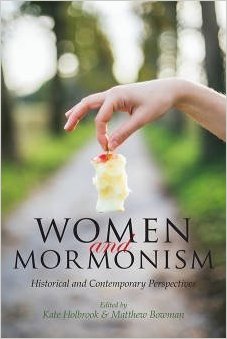 Kate Holbrook and Matthew Bowman, Women and Mormonism: Historical and Contemporary Perspectives (University of Utah Press). There are a lot of edited collections out there, especially in Mormon history, but a majority of them fall by the wayside within a year or two, never to be heard from again. (There’s a reason most academic presses are turning away from multi-author volumes, save for rare exceptions.) Yet this is one edited collection that I really think will stick–its collection of authors, diversity of disciplines, and coverage of topics make it a crucial book for anyone interested in Mormon women’s history. I’d venture to say it’s the most important multi-author work on the topic since the famous Women and Authority in 1992. I’ve only read about half of the chapters thus far, but they have all been excellent. I was also in attendance for the conference upon which this volume is based and can attest to the energy and excitement that was involved.
 Speaking of multi-author volumes, Patrick Mason, ed., Directions for Mormon Studies in the Twenty-First Century (University of Utah), is also the result of a conference. This event was a festschrift in honor of Armand Mauss, one of the great scholars of Mormon history, and it takes a multi-disciplinary look at the future of the field. While history has long been the premier discipline within the subfield of Mormon studies, it has long been hoped that new approaches would be quickly added. The papers in this volume point to a number of possibilities, including with sociology, autobiography, and ethnography. Still heavily history, of course, but at least hints to a non-history-centric focus. It reminds me of Quincy Newell and Eric Mason’s New Perspectives in Mormon Studies: Creating and Crossing Boundaries (University of Oklahoma Press, 2013), which performed a similar work. The two volumes compliment each other in nice ways.
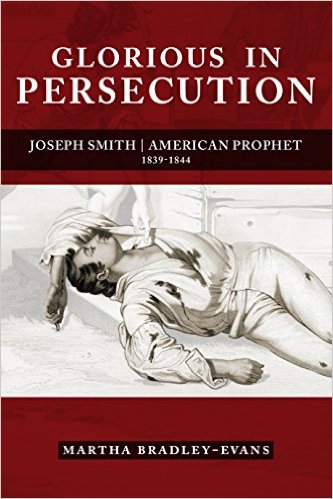 Finally, Signature Books offered two new volumes. The first, Island Adventures: The Hawaiian Mission of Francis A. Hammond, 1851-1865, edited by John Hammond, offers an acute overview of an important early missionary focus; I’ve had an ARC of the volume sitting on my desk for a month, and the few times I’ve dove in have rewarded me with rich textual excerpts. I look forward to more exploration. The other one is a book long-awaited in MHA’s community: Martha Bradley-Evans’s Nauvoo-era biographical study of Joseph Smith, Glorious in Persecution: Joseph Smith, American Prophet. Part of a trilogy Smith-Pettitt commissioned quite some time ago, it is the first of the three parts to appear. (The Van Wagoner, Natural Born Seer, which covers Smith’s life through 1830, will appear in a couple months.) I’ve already given Glorious in Persecution a quick read-through, and am now giving it a much deeper look since it overlaps with my current Nauvoo project. I’ll probably write a more in-depth review of it later, but there are a lot of things I love in it (her theoretical approach to Smith is long over-due and provocative) and a few frustrations (her reliance on problematic sources and lack of engagement with recent scholarship). A must-read, though, for those interested in the Nauvoo period.
 Benjamin E. Park