CFP: Toward a Conversation on Book of Mormon Studies

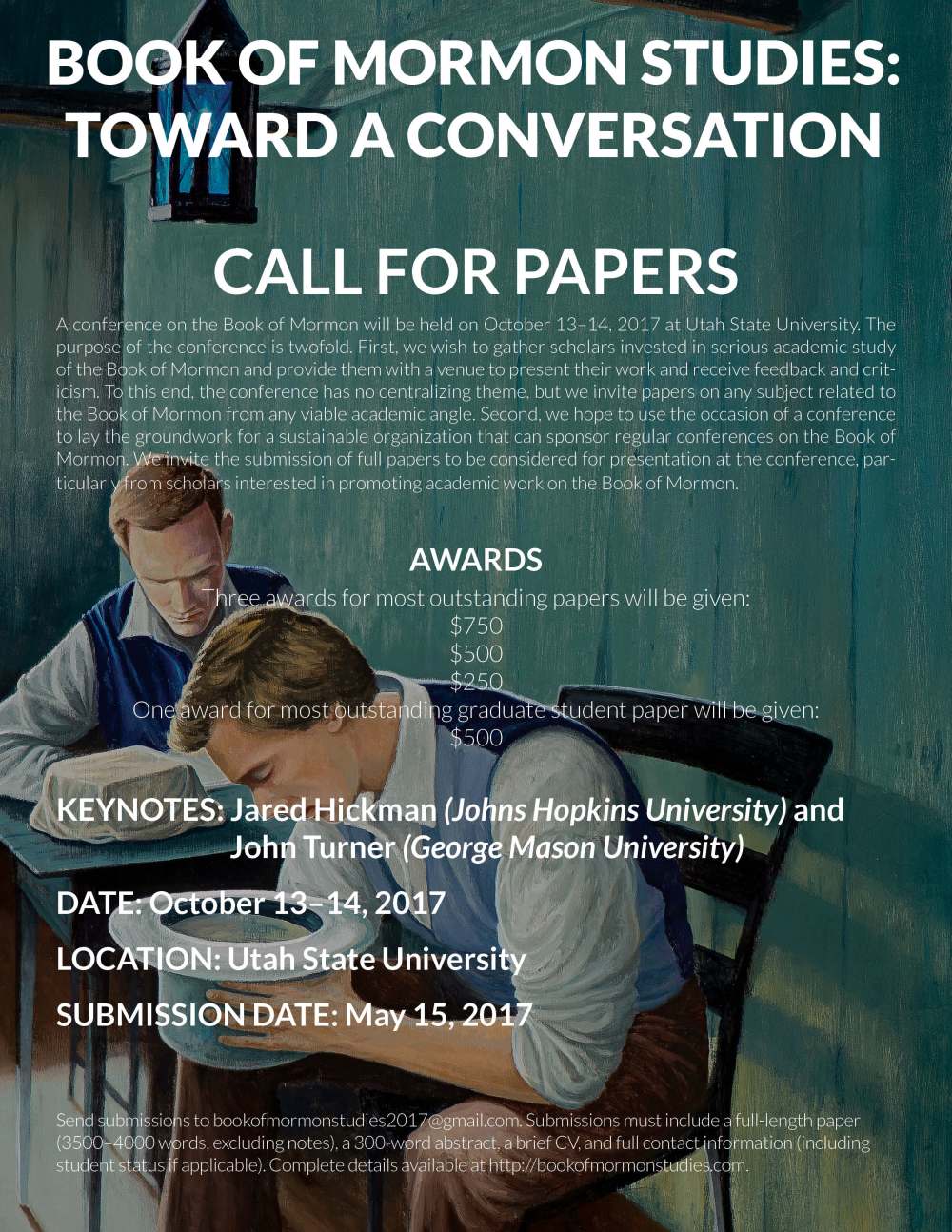
Some good friends of mine are launching a new conference and organization, so please check out the details. Here is a poster, and I’ve pasted the text from this pdf file below that.2017-bom-conference-cfp-poster-lower-res

Academic study of the Book of Mormon has never been more promising than at present. Royal Skousen’s work on producing a critical text is nearing completion, and the Joseph Smith Papers Project is making the manuscripts of the Book of Mormon widely available. Terryl Givens and Paul Gutjahr’s work has provided a basic outline on the reception history of the book. Brant Gardner has provided students of the Book of Mormon with a richly sourced and substantive commentary. Grant Hardy has introduced the content and the depth of the Book of Mormon into the larger academic world, and scholars associated with Community of Christ have recently made a case for renewed interest in the volume. The Journal of Book of Mormon Studies has begun to provide a space where various kinds of serious research on the book can be published. Book of Mormon Central has laid the foundation for a comprehensive archive of previous scholarly work. The Mormon Theology Seminar has begun assembling a body of close theological readings of specific texts. And promisingly, non-Mormon academic presses and journals have begun to publish important work on the Book of Mormon.

In the hopes of furthering all these developments, and of encouraging the pursuit of other directions, we would like to announce a conference to be held on October 13–14, 2017 at Utah State University. The purpose of the conference is twofold. First, we wish to gather

scholars invested in serious academic study of the Book of Mormon and provide them with a venue to present their work and receive feedback and criticism. Ultimately, we aim to foster a community of academics interested in the Book of Mormon. To this end, the conference has no centralizing theme, but instead invites papers on any subject related to the Book of Mormon, from any viable academic angle. Second, in gathering interested scholars, we hope to use the occasion of a conference to lay the groundwork for a sustainable (but minimal) organization that can sponsor regular (annual or biannual) conferences on the Book of Mormon. To this end, the conference will include a meeting attempting to institutionalize a regular, repeating event for gathering scholars working on the Book of Mormon.

We therefore invite the submission of full papers to be considered for presentation at the conference, particularly from scholars interested in promoting academic work on the Book of Mormon.

AWARDS

Three awards for most outstanding papers will be given:

$750 first place

$500 second place

$250 third place

One award for most outstanding graduate student paper:

$500

KEYNOTES: Jared Hickman (Johns Hopkins University) and John Turner (George Mason University)

DATE: October 13–14, 2017

LOCATION: Utah State University

SUBMISSION DATE: May 15, 2017

Send submissions to bookofmormonstudies2017@gmail.com. Submissions must include a full-length paper (3500–4000 words, excluding notes), a 300-word abstract, a brief CV (no more than two pages), and full contact information (including student status if applicable). Complete details available at http://bookofmormonstudies.com.

The Modern Mormon Athletic Image

Mormons have always held a precarious yet consistent place in America’s sports culture. Danny Ainge, Steve Young, Ty Detmer, and, most recently, Jimmer Fredette are among those have captured the nation’s popular imagination at various moments in the past four decades with their college accomplishments and, at least in the first two cases, professional success. (Still cheering for #Jimmertime success in China, of course!) The gritty workhouses of LDS communities, whose churches feature indoor basketball courts and bloody youth leagues, have produced constant competitors that seemed disproportionate to their small population. In short, Mormons know how to play ball.

Two things stand out about these figures. First, they were all funneled through Brigham Young University, the Church-owned flagship school located in overwhelmingly-Mormon town of Provo, Utah. And second, they were all white. (They are also all male, but I’ll leave the important gendered dimension for future consideration.)

Those facts themselves are central to the modern Mormon athletic image. (Or, as I’ll argue in a minute, they were until very recently.) On the basketball court, the “white dudes” at BYU are known for their three-point shooting, consummate teamwork, and hustle–you know, the facets of the game typically tethered to non-athletic white kids. As Matt Bowman has argued, these very characteristics reaffirmed classic stereotypes of the Mormon community. On the gridiron, the BYU cougars simultaneously hearken back to a classic age of pigskin orthodoxy mixed with the modern-day west-coast offense. Hunter Hampton has studied how BYU’s football program was, in some ways, an explicit vehicle through which Mormons attempted to assimilate into a particular Christian community. Of course, like most of Mormonism’s assimilation projects, they got a seat at that table only when the national mainstream left it for another. The 1984 national championship of yesterday is seen, then, as the contrarian triumph to the me-now, selfish, star-driven brand of SEC football today. What I’m emphasizing, anyway, is that the Mormon sports identity is closely aligned to their concomitantly conservative cultural identity.

With that background, let me now note the stark divergence seen in Mormonism’s three most prominent athletes today: Bryce Harper, Manti Te’o, and Jabari Parker. All three break significant cultural expectations for Mormon athletes. None of them were raised in Utah or attended BYU. Two of them are not white. One of them has made a point to speak out on progressive social issues. Together, they point to what may be the future of Mormonism’s public image.

Besides his classic “clown question, bro” retort, Bryce Harper has embodied the figure of a modern-day superstar. Though immensely talented (and immaculately sculpted), he has been accused of being selfish and temperamental by old-fashioned columnists. He is not the shy, soft-spoken, and reluctant figure typified by an LDS athlete. In many ways, Jimmer Fredette paved the way for this modern-day Mormon superstar, as outlined, again, by Matt Bowman: both athletes broke with Mormon trends of team-centered, cooperative play in favor of transcendent superstardom in the form of a Michael Jordan. This is assimilation into contemporary popular culture reflective of the post-Hinckley era. And with Harper, his professional play actually justified the hype. (But I still love you, Jimmer!) One of the hottest discussions in Major League Baseball right now is whether Harper will sign an astronomically high salary that breaks all previous precedents, or if he will become the newest high-priced and highly-acclaimed free agency savior of the pin-striped evil empire. (Ironically, it’s Harper’s contemporary rival, Mike Trout, who fits the traditional Mormon stereotypes of being quite and unassuming with a humble and workman-like persona.)

Things are more complex with Te’o and Parker, especially with the racial component. Both players made a conscious decision not to attend BYU, even though the school was amongst their finalists. (BYU students even made an, um, interesting recruiting pitch for Parker.) Te’o was one of the most decorated defensive players in recent history at Notre Dame and, after the notorious and humiliating fake girlfriend scandal (which deserves its own dissection within the Mormon context), has carved out a solid, though not yet exceptional, career with the San Diego Las Angeles Chargers. He led the team in tackles in 2015 and was voted as captain of the team the following year, but missed most of the 2016 season with injury. Of course, Te’o represents Mormonism’s long-standing Polynesian culture which has taken an increasingly prominent role in BYU’s football culture, as seen with their recruiting history, pre-game performances of the haka (which has caused some debate), as well as their recent coaching hire. They even made a video about this cultural link. If Te’o returns to stardom in the years ahead, he will help project this image nation-wide.

Raised in urban Chicago, Jabari Parker is my favorite challenge to the stereotype of Mormon athletes. He spent one year at Duke before being drafted by the Milwaukee Bucks and blossoming in his third year. Prior to succumbing to a season-ending knee injury last week (apparently another characteristic of the modern-Mormon image), he was averaging twenty points per game and considered a borderline all-star. Most importantly, Parker was the subject of an excellent Ringer profile last week that highlighted his social awakening and decision to speak out on racial issues. (It also mentioned that he only became aware of Mormonism’s racial restrictions while a college student–that must have been awkward.) If Parker continues his upward trajectory and commitment to speaking out on national issues, he’ll be a fascinating and significant figure in modern LDS culture. I, for one, have become a Bucks fan with him on the team.

It remains to be seen how much of an impact these athletes will have in Mormon, sports, and American society. But I think they represent an undeniable shift. One of the next big Mormon athletes, Frank Jackson, is another African American basketball player who is following Parker’s route through Duke. (Though he attended High School in Utah County, most of Jackson’s upbringing was in the DC area.) Even BYU’s football team has adopted a more diverse image, as football coach Kalani Sitake has infused the program with much-needed pep. (And as they try to recover from a checkered racial past.) Just check out their team hype video from the last year, which would have been unthinkable in previous generations:

This isn’t your grandfather’s BYU.

As the Mormon faith and community moves to adopt a more diverse image, it makes sense that athletes would lead the way. Sports has long been a venue for cultural transformation within the LDS tradition. Following the careers of these current athletic stars, then, offers insights into the overall trajectory of the church they happen to represent.

Book News: “American Nationalisms” Now Has a Home

When I was a graduate student at the University of Cambridge, I often walked past the Cambridge University Press bookstore that was directly in front of Kings College Chapel. They always had the “recent releases” on display, and I spent many hours skimming through their pages. I dreamt that one day I might add my own work to that long tradition of solid and sophisticated work. 

Well, I’m honored to share that I’m a little closer to that goal. Cambridge University Press has agreed to publish my book manuscript, “American Nationalisms: Imagining Union in an Age of Revolution.” It’s probably a clerical error. But until they come to their senses, I’m thrilled to be attached to such a prestigious publisher. 

Here is a brief summary of the project from my personal website:

This book seeks to identify the roots of America’s cultural tensions by chronicling the earliest cultivations of, as well as oppositions to, ideas of nationality during the country’s first fifty years of existence. It examines how the practice of nationalism took place in three specific contexts—Massachusetts, Pennsylvania, and South Carolina—between the end of the Revolution in 1783 through the Nullification crisis in 1832-33. American Nationalisms argues that conceptions of national identity varied dramatically during this period, and that assuming a unified narrative distorts a dynamic and diverse reality. And in doing so, it further demonstrates how theoretical constructions of nationalism were tethered to personal backgrounds, regional cultures, parochial concerns, and localized political systems.

Depictions of nationalism were more than just cultural rhetoric, a political by-product, or a partisan tool, though they certainly played all of those roles at various times. This manuscript argues that they also functioned as opportunities to think about community, cultural frameworks for understanding political union, and ideological instigators for policy, action, and thought. How one conceived America to be, or how one conceived America should be, led directly to political beliefs and practices. While a wide array of elements resulted in distinct American cultures moving apart from each other during the early nineteenth century, and though all these elements were interdependent and reciprocal, a crucial component was the growing chasm between how various states understood “nationalism” and “union.” In order to understand national fracturing, then, it is important to chart contestations over nationalism.

And finally, the book situates these cultural expressions within a broader and comparative Atlantic framework that includes similar debates that were taking place in Europe, especially in Brtain, France, and Germany.

Articles that draw from this project will appear in the spring issue of Early American Studies and the fall issue of Journal of the Early Rpublic. I’ll highlight those when they appear. 

I am working hard to revamp the introduction and conclusion, the only portions of the manuscript that still require substantive revision, and then it will go through the editing and production phase. If all goes to plan, it should arrive on bookshelves (including in the shop across from Kings College Chapel!) in about a year. 

Blogging about Robert Orsi at Juvenile Instructor

The Juvenile Instructor has been running a series on Robert Orsi’s newest book, History and Presence. I was privileged to contribute the third entry. You can read it here. And below is an excerpt. 

One final thought from the chapter. Robert Orsi concludes this topic by addressing the scholarly (and modern) anxiety to find a purpose in these abundant events that match our own values. When talking with the woman who endured frequent sexual abuse as a child, he caught himself hoping she would say something to imply that religion gave her a way to feel “empowered” against such egregious evil. But that solution he desired was not hers. “One of the things I have found over the years,” he realized, “is that very rarely, if ever, do the people we scholars of religion talk with and write about need our protection, because what we are protecting them from is the judgment and condescension of critical theory. In other words we are protecting them from ourselves” (111). In our attempt to transform the religiosity of nineteenth-century Mormon women into modern-day suffragists, are we forcing them into categories they would reject? Does that matter? How can we better analyze claims of religious experience in their own terms, rather than our own

I strongly recommend the book. I’ve assigned several of his monographs in my classes before, and you can read my thoughts on why his work is relevant for Mormon history here

Barack Obama, Eddie Glaude, and the Black Prophetic Tradition

I’ve always been an apologist for Barack Obama since reading Audacity of Hope shortly after it was published in 2006. I think he’s the most careful and sophisticated interpreter of and proponent for deliberate democracy to be elected president in over a century. I was therefore really excited to receive the first substantive edition of his presidential addresses, We Are the Change We Seek: The Speeches of Barack Obama (Bloomsbury, 2017), edited by E. J. Dionne and Joy-Ann Reid. It was a rewarding experience to read through some of these classic speeches, many of which still move me today. Found within those words is the message of hope and change that first made me interested in presidential politics–not to mention awaken me from my previous political views–and it reaffirmed my proud feeling for having supported Obama for the past four years. Compared to the words and orders currently coming out of the White House, Obama’s message felt like healing balm.

But I must admit that I’ve become increasingly skeptical concerning the power of Obama’s overall narrative of hope. I’ve blogged previously about how the President embodied only one tradition within the black political legacy, and that it actually diverged in significant ways from the radical message of more prophetic voices like Martin Luther King Jr. Obama’s message of hope draws from the classically liberal philosophy of progressive change over time, the fervent belief that society is moving toward a better good, despite temporary reverses and roadblocks. No matter America’s shortcomings in the past, her ideals still hold pure today, and the goal for the reformer is to better align the America’s reality with America’s principles. On the other hand, the prophetic tradition, as exemplified by those who pushed for Civil Rights, believed that humanity tended toward sin and corruption, that society was prone for stagnation, and that change only came through radical action. Theirs was not a message of hope but of direct protest.

Besides Ta-Nehisi Coates, whose Between the World and Me is a manifesto for the #BlackLivesMatter movement, is the most persuasive voices for this prophetic voice today. His story is much more gritting, realistic, and often has little room for Obama’s optimism. Indeed, Coates’s phenomenal long-form Atlantic article last year, “My President Was Black,” argued that Obama could only be elected because he wasn’t from this more pessimistic tradition.

But another significant voice is Eddie Glaude, who teaches religion and African American studies at Princeton. It was quite a juxtaposition, then, that the same weekend I (re-)read Obama’s famous addresses I also read Glaude’s fantastic Democracy in Black: How Race Still Enslaves the American Soul (Crown, 2016). (I know, I know; I’m a year late.) In many ways, the latter is meant to be a direct indictment of the first. Glaude, while acknowledging much of what Obama accomplished and symbolized, still identified him as a “confidence man” who “sold black America the snake oil of hope and change” by saying what the nation wanted, rather than what we needed, to hear. Most of his policies, including the My Brother’s Keeper initiative, were merely “a Band-Aid for a gunshot wound.” Glaude didn’t mince words. Most chapters identified structural problems with American society, rooted them within historical and cultural contexts, and then emphasized Obama’s inability and unwillingness to actually address either.

At the center of Obama’s shortcoming, according to Glaude, is his commitment to an American ideal. A metaphor of American exceptionalism, the belief that underneath the struggles there are transcendent American values. As a firm believer in the nation’s democratic ideals, Obama, like many white liberals, casts the country’s problems as “aberrations” rather than concluding that “inequality and racial habits are part of the American Idea.” Specifically, white supremacy–which Glaude defines as “the way a society organizes itself” based on “a set of practices informed by the fundamental belief that white people are valued more than others”–has always been the governing mechanism of America’s political tradition. A failure to recognize that foundational fact renders any reform effort as inadequate. Instead of addressing entrenched racial habits embedded in society, we instead perform “racial theater” whenever a particular moment of race violence crops up, only to return to the status quo weeks later. That Obama’s tepid remarks following the episodes of Jeremiah Wright, Trayvon Martin, and Michael Brown are heralded as landmark addresses only shows the depressingly low boundary for discourse. Here’s Glaude on Obama’s speeches concerning race:

For much of his presidency, Obama constantly contorted to avoid the racial land mines of American politics. The acrobatics affirmed the troublesome idea that serious engagement with racial inequality in this country is anathema. The irony is glaring, isn’t it? The first black president can’t call attention to the racial habits that get in the way of genuine democracy, but his election can read some to believe the illusion that we are post-racial.

It is in this way that Obama’s presidency could be as much a hindrance to black equality as an accelerant. Conservatives can proclaim that we have made progress by electing an African American POTUS, yet little progress toward racial rights actually take place. In Obama’s reticence to inflict “white fear,” the inevitable backlash to steps toward racial equality, he was severely limited in what he could say and accomplish. He constantly had to reaffirm that he was “not the President of Black America”–as if there haven’t been plenty presidents of “White America”–and he often justified, rather than attacked, white rage. In his address distancing himself from Reverent Jeremiah Wright’s rhetoric, for instance, Obama equated Wright’s prophetic anger with that felt by his white grandmother who distrusted black men. As if both of those feelings were based on similar foundations. And to preserve his message of “hope,” he typically fell back on the classic narrative of self-help, community decay, and slow-form liberal progress. Glaude explains how the threat of white fear curtailed much of Obama’s words.

White fear requires that we make white people feel comfortable about race…It also entails translating the specific concerns of black communities into something more universal issue can’t be all about black people. We have to lift all boats. All of this happens because of one unmistakable fact: if we talk directly about black suffering in this country we risk alienating of large segments of white America, jump-starting their fears…Obama’s election did little, if anything, to uproot [these fears]. In fact he conceded to their terms.

Rather than assuaging fear, Glaude argues, we should instead directly confront it. Until that blockade is toppled, efforts for racial equality will be severely limited. In this context, the “No Drama Obama” mantra takes an ominous hue.

Glaude’s book is far more than a critique of Obama. Rather, it is a careful overview of what he calls the “Black Great Depression” that has plagued African American communities long after the Great Recession subsided. It also posits tools for future battles, focusing specifically on local activism. I heartily recommend it.

But I was particularly taken by yet another example of the poignant divergence within the black political tradition. (Or should I say, traditions.) And it made me reconsider my own love for Obama’s speeches. Am I attracted to them because they console the precious myth of white liberal progress? Does my own background and privilege predispose me to sympathize with a philosophy that doesn’t rock the boat? Obama’s message makes me feel good–gives me goosebumps!–but Glaude’s reminds me that I should feel uncomfortable.

As a historian, I should recognize that history’s biggest moments are rarely those that reaffirm traditional values, but rather introduce new ones.