Reflections on the Recent Issue of Journal of Mormon History

I finally go around to reading the most recent issue of Journal of Mormon History. As always, there was a lot to chew on. Here are just a few highlights.

  • I really liked Matthew Dougherty’s sophisticated and provocative article, “None Can Deliver: Imagining Lamanites and Feeling Mormon, 1837-1847.” This essay added a new lens to an important topic, how Mormons conceived of Native Americans, in an impressively theoretical way: the study of emotions and feelings. How did the image of Indians validate Mormon beliefs concerning chosenness and millennial justice? Lots of scholarship has pointed to Mormon alliances with indigenous tribes, something that seemingly makes them unique, but Dougherty convincingly highlights how Mormons appropriated common racial beliefs in doing so. (Including support for forced Indian removal.) And in looking toward the Amerindian apocalypse, Mormons were anxious to cast off the feeling of violent justice off their own shoulders.  “Early stories about Lamanites, then,” the article explains, “did not exalt American Indians above white Mormons but rather suppressed or downplayed Native people’s actual needs in favor of imagining a holy people who could enact Mormon prophesies” (44). Mormon conceptions of interracial unions were complex.
  • I also enjoyed Matthew Godfrey’s “Wise Men and Wise Women: The Church Members in Financing Church Operations, 1834-1835,” which is a straight-forward account of fundraising efforts in Kirtland. It turns out that churches need money to survive, especially if they have grand expectations for audacious projects. As such, the young LDS faith was in constant need for cash. Lacking the business endeavors of the later Utah period, not to mention a standardized system of tithing, they turned to donations. This is where average members came in. I especially appreciated the attention to women, many of whom we know too little about. This is another example of how the large designs of church leaders would not have existed if not for popular support.
  • Some of the best work JMH publishes is outside the narrow boundaries of history. James Swensen’s “Reflections in the Water: An Exploration of the Various Ises of C. R. Savage’s 1875 Photograph of the Mass Baptism of the Shivwit” is a great example. Swensen, who teaches art history, traces the reception history of a famous picture. (It’s the image featured in this post.) Taken when over a hundred members of a local tribe entered the Mormon fold, the image had a long shelf life. To Mormons during the 1870s, it represented a fulfilled promise that the Lamanites would accept the gospel; to gentile observers, it was proof of the Native/Mormon alliance. Later, scholars used it as evidence of cultural imperialism; conversely, others argued it depicted Native People exercising agency and making diplomatic alliances.
  • The other articles are also excellent. Two of them, by Alisha Erin Hillam and Darcee Barnes, were written by independent historians, and represent the broad tent JMH does (and should) create.
  • There is an exceptionally long book review section, which I understand is due to an error. (The reviews from the previous issue weren’t printed, so they were doubled up in this one.) As always, the quality of these reviews can be uneven, but there are plenty of good ones. My favorites were those written by grade students who display an exciting grasp of new historiographies. This includes not one but two reviews by Cristina Rosetti, a PhD candidate at UC-Riverside, as well Joseph Stuart, a PhD candidate at Utah. But also check out Matt Bowman’s thoughtful take on Tom Simpson’s award winning American Universities and the Rise of Modern Mormonism.
  • I especially enjoyed the exhibit review by Richard Bushman, where he reacts to the year-old remodel of the LDS Church History Museum. The prose is quite flowery (the museum could use portions of it for marketing brochures!), but he also raises incisive critiques. (Besides that, as an octogenarian, he missed the old escalators and had to anxiously look for the elevators.) Bushman notes that the museum has a bit of difficulty handling the Book of Mormon. How should one square this ancient record with a modern story? They chose to merely tell it within the context of Joseph Smith’s own life, rather than dwell on its historicity claims. Second, the exhibit demonstrates some transparency (seer stones and polygamy) but in limited ways (doesn’t depict Smith using the stones, and no mention of Smith’s own polygamous practice). And finally, Bushman explains that the new exhibit both condenses and expands the story: condenses, because it cuts the tale off at Nauvoo; expands, because it focuses on he broad concept of visions. “The parochial story of Utah and the gathering gives way to the universal story of a new revelation” (147). I appreciate this take, but I do note the irony that, in a day when the Church History Department is more focused on global stories, the entire first floor of its museum is dedicated to twenty years of an American tale.

Anyways, it’s a solid issue. Happy reading!
Thomas Jefferson, White Supremacy, and Last Night’s March in Charlottesville

Last night, several hundred individuals bearing torches marched on the University of Virginia to protest the removal of Confederate monuments. They chanted “White Lives Matter,” denounced racial diversity, and insisted that white Americans could not be “replaced.” This type of episode has become more common in Trump’s America, as the election of someone who ran a campaign based on deliberate race-baiting has unleashed and justified a torrent of racist actions across the nation aimed to marginalize minority voices. Some observers are consistently shocked at this—they point to the clean-shaven faces, modern clothes, and generally modern appearance of the protesters. One internet meme dubbed them the “Nazis of Pier One Imports.” The constant surprise at these developments, however, belies the persistence of this very tension at the heart of American culture.

That the march took place in Charlottesville, on the campus for a university founded by Thomas Jefferson, is tragically fitting. Jefferson is best known as author of the Declaration of Independence, and the ideal that “all mankind are created equal” is what is still at stake. But Jefferson also authored—as well as enacted—a number of racial beliefs that excluded non-whites from the American political body. Even when he confessed that slavery was a moral wrong, a tenuous position that was always more an abstract ideal for him than a driving principle, he could not envision a mixed-race society. His idea of a nation was rooted in racial homogeneity. In his Notes on the State of Virginia, Jefferson explained why the emancipation of slavery could only be coupled with the forced removal of the black population:

It will probably be asked, Why not retain and incorporate the blacks into the state, and thus save the expence of supplying, by importation of white settlers, the vacancies they will leave? Deep rooted prejudices entertained by the whites; ten thousand recollections, by the blacks, of the injuries they have sustained; new provocations; the real distinctions which nature has made; and many other circumstances, will divide us into parties, and produce convulsions which will probably never end but in the extermination of the one or the other race.

This quote was what immediately came to mind as I looked at pictures of white supremacists marching near the University of Virginia’s Rotunda. Racial tension has always been part of America’s nationalist imagination.

As I have previously written, these racist outbursts have always been central to the American political tradition. Respectable, educated, and, indeed, “modern” individuals have long envisioned a nation based on white supremacy. That included the president whose campus the protestors marched on last night. We won’t be able to address this predominant sin of American racism until we acknowledge how rooted it is in our culture. It will require much more than just historical amnesia to forge a more inclusive patriotism.

Trump’s victory did not reawaken white supremacy, but rather merely provided the cover for its open performance. The national sin of racism has been with us all along, whether we admit it or not.

Reading List for Religion and America’s Founding

This morning I am giving a presentation to teachers from the Conroe Independent School District on religion and the founding. Since I am morally opposed to providing paper handouts, I am posting here the list of resources that I recommend to those who wish to dig deeper into the origins of America’s religious tradition. This list is not exhaustive, but rather introductory.

Review: Brent Rogers, UNPOPULAR SOVEREIGNTY

A hard confession from someone who specializes in the early republic and antebellum periods: the 1850s is my favorite decade to teach in the American survey. It always feels like my lectures are a sprint throughout he semester, given the nature of the course, but it still seems to pick up speed once we hit the Compromise of 1850, and we don’t get another breather until The corrupt bargain of 1877. (I can never skimp on Reconstruction, especially given today’s circumstances.) I say this is a hard confession because my own research ends in the 1840s, so you’d think I’d prefer the weeks that precede these lectures. But there’s something about the 1850s that really captures me.

Unpopular Sovereignty: Mormons and the Federal Management of Early Utah Territory (University of Nebraska Press, 2017), Brent Rogers’s new book, helped me finally put my finger on what it is about the decade that grabs my attention: the sheer audacity of imperial desires, the violent results of local implementation, and the juxtaposition of sophisticated political theories and parochial hypocrisies dominated the American landscape. These tensions had been around since the beginning, of course, but they were brought to the foreground as soon as the nation finally possessed a continent-wide empire. It is ironically tragic, of course, that the fulfillment of that long-held dream was what cemented the Union’s (temporary) dissolution.

Utah Territory in 1850 was part of a large swath of land theoretically governed by the federal government. In reality, though, the area west of the organized states was an arena for racial, political, and provincial squabbles. This was no small region under the careful thumb of Uncle Sam: the square mileage of the territories outnumbered that of states. America was finally an empire, but one that was spread razer-thin. Determining how to colonize, organize, and integrate this region was of national significance. Historians of early Utah have often emphasized the tense relations between LDS leaders and national politicians, but few have adequately contextualized the episode within this much broader question of federal governance in an era of over-expansion. Rogers’s book exhaustively overviews the political interplay between the Mormon people, with their theocratic ideas and people spread across the Rocky Mountain region, and the Washington DC leaders, who tried to corral their renegade zealots even as they simultaneously attempted to hold their nation together.

Central to these 1850s debates was the idea of popular sovereignty. Most know the concept from its most prominent proponent, the “little giant” Stephen A Douglas. Basically, it was the belief that these western territories should be able to determine their own fate rather than rely on federal intervention. The issue most relevant to this concept, of course, was slavery. How should the nation decide which new states carved from the expansive western area would be slave or free? Douglas proclaimed that the federal government had no business solving this question at all. He worked to pass the Kansas-Nebraska Act, which overturned previous congressional ruling regarding the fate of slavery in those territories. Students in my survey courses become well aware of Douglas’s popular sovereignty philosophy when we dissect his famous debates with Abraham Lincoln. I’m sure this is quite common in classrooms throughout the nation.

So what does Mormonism have to do with popular sovereignty? Rogers argues that, like Kansas, Utah “emerged as a key battleground and hotbed of antebellum debate over popular sovereignty” (3). If western territories should be granted the autonomy to govern themselves, what about the Mormons? Federal dealings with Utah proved that popular sovereignty was not a monolithic one-size-fits-all philosophy. The strength of Unpopular Sovereignty is found in Rogers’s exhaustive overview of competing ideas concerning democratic governance in the West. The federal government was surprisingly adaptive. At the heart of the issue was a question of civilization: Who could be trusted to govern themselves? Southern slaveholders? Mormon polygamists? Native tribes? These three groups, along with others, were found on a spectrum of political philosophies that were never full comprehensive nor coherent.

I wish Rogers would have spent a bit more time on the racialization of popular sovereignty and democratic governance. He does have a chapter on the relationship between the Mormons and their Indian neighbors, both the real connections as those imagined in Washington, but he mostly dealt with them as political bodies. Popular sovereignty, I’d argue, was built upon ethnic conceptions of belonging and nationhood. Paul Reeve’s recent book highlights this, but the political dimensions of this angle should still be unpacked. The place of racial minorities was a crucial topic for the American nation at the time, especially with the newly-acquired land from Mexico, and Mormons played into that debate as well. Whiteness and American westward imperialism still needs more work. That’s likely too much to ask for an already hefty tome that has dug so deeply into other topics, however.

Rogers makes several key historiographic interventions, both in political and Mormon spheres. His work on the plurality of popular sovereignty adds to a lively discussion on what was previously a staid topic. His comparative work on Kansas and Utah also demonstrates the fraught nature of democratic experiments in the 1850, proving that popular sovereignty was contested even within the Democratic Party. And his argument that the Utah War in 1857-58 set the stage for nation schism (Southerners saw it as a challenge to local sovereignty, and Republicans used it as evidence for the Democrats’ hypocrisy) contributes an intriguing nuance to a crowded narrative. Historians of American politics will learn a lot about the vagaries of democratic discourse, and teachers should have new material to share in the classroom.

And what about the Mormon historiographic sphere? For starters, Rogers demonstrates one way to overcome the “donut hole” problem of western history. (That traditional narratives of the American West circle around Utah but never really integrate the state and its Mormon residents.) The Mormon clashes with federal government in the 1850s was not completely unique, but rather part of a much larger moment of imperial expansion and related to questions concerning federal governance. And Rogers’s focus on the multiplicity of opinions on either side of the divide—neither the Mormons or their opponents were ever notably consistent—breaks down the tired bifurcated narrative of saints vs. gentiles. His is a model of integration and nuance.

The book became quite long and meticulous at times—perhaps like this review?—but overall I found it quite compelling. It interweaves published and private writing, not to mention useful maps, into a grand story of federal conflict. I hope it is a sign of more scholarship that better situates Mormonsim into America’s quixotic history of democracy.

Review: Eric Hinderaker, BOSTON’S MASSACRE

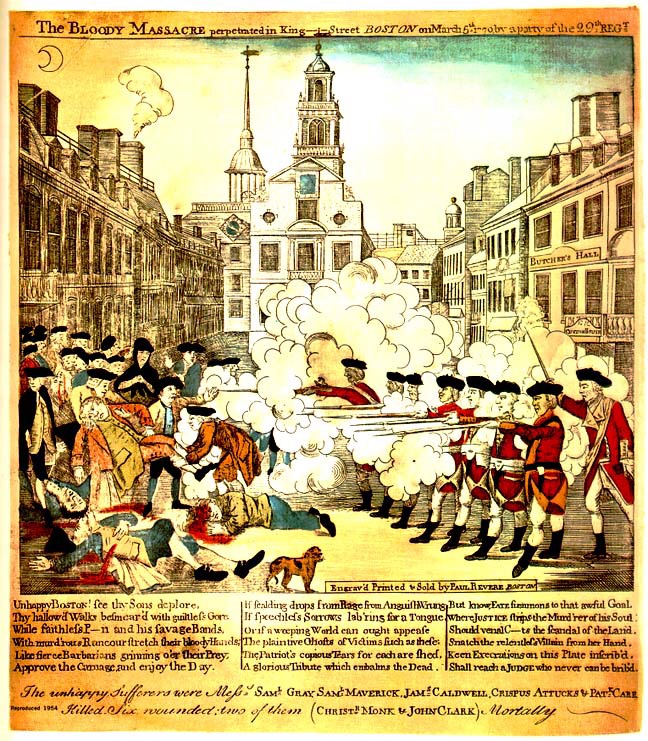
The Boston Massacre has loomed large in America’s historical memory. Taking place five years before the battles at Lexington and Concord, the episode featured British soldiers firing into a gathering of unarmed colonists. Four died on the scene, and another succumbed to mortal wounds a few days later. The moment and its martyrs were immortalized in a famous Paul Revere illustration that same year:


But the story has complex legacies. Was this a significant step on the way to rebellion and independence, or was it the result of an unruly mob? Those who watched the HBO series John Adams might have been surprised that Adams defended the British soldiers. He argued that they were being cornered, bullied, and pelted with snow and ice by the cities miscreants. They were hooligans, in other words. Those actually protesting British rule, Adams claimed, were much more orderly. His argument was successful, as they were all acquitted.

But that does not mean the “massacre”—a term that is itself a politicized description, just like Adams’s use of “mob”—does not reveal a lot about the coming of the American Revolution. Eric Hinderaker’s new book, Boston’s Massacre (Harvard UP) uses the episode to tell a much larger story. Besides giving an exhaustive overview of the events that transpired on March 5, 1770, including extensive details concerning the city and its governing structure, Hinderaker explores the world that led to it as well as the multiple worlds it created. This story is both explicitly intimate—when learning about all the various people who played leading roles in the story, I was reminded of how small and parochial Boston really was—as well as exceptionally broad, as it situated Boston within an immense and evolving British empire.

The first half of the book is a series of thematic chapters focused on different lenses through which to see the massacre’s origins. For example, one chapter discusses changing beliefs concerning a standing militia within Britain and her colonies, and another details how resistance efforts operated in the half-decade following the Stamp Tax ordeal. The Massachusetts colony was a proud participant in the effort to build Boston as an imperial space, and only came to regret it when that very power was turned against against their residents. The story of Britain in the mid-eighteenth century is the birth of a militant power. When the empire won broad new swaths of land from France, it inherited dozens of forts and thousands of miles that had to be guarded. This required a radical expansion of the standing army. Those in the colonies were not used to these new circumstances and often fought back. Hinderaker’s analysis usefully interweaves comparative examples to help understand the Boston experience, including those inside Britain (Ireland) as well as outside (Spanish New Orleans). I learned quite a bit concerning how imperial militias were governed, moved, and housed in the early-modern period.

And then there’s the massacre itself. The most striking detail about Hinderaker’s account is how up-front he is concerning how little we know about it. He digs through particular interviews, trial notes, prosecution and defense arguments, as well as propaganda, and concludes that nearly all of it is clouded by agendas. Did the captain instruct the soldiers to fire? Were there more shooters on the second floor of the customs house? While Hinderaker explores these questions and provides exquisite detail, he concludes that much of the event will remain a mystery. What is clear, though, is the surrounding circumstances: Boston had become a crowded city with unwanted soldiers housed in makeshift barracks and gunning for the locals’ jobs. At the very least, they were an affront to the city’s character. The massacre was the culmination of imperial conflict. But some in the town also saw the mob violence that led to the shooting as equally contemptible. In defending the soldiers, John Adams and his fellow lawyers sought to save their city’s reputation by blaming it on the neighborhood’s miscreants; most notably, he played up the role of Crispus Attucks, a slave of Native and African American descent, who Adams differentiated from the calm, reasonable, and collected patriots of Boston.

The book takes a different approach once the trials are concluded. The final chapters focus on how the meanings of the massacre evolved over time. Hinderaker persuasively demonstrates that the event drew little attention outside of New England—or even Boston, for that matter—for quite some time. But it certainly became part of the city’s consciousness during the Revolution. Annual lectures commemorated March 5 for a decade, and speakers highlighted British tyranny and colonial innocence. But the event’s importance subsided after the conflict’s conclusion in 1783. From that point on it was a point of ambivalence. Highlighting it did indeed cement Boston’s role in the revolutionary struggle, but it also opened them up to accusations of lawlessness. This anxiety has persisted ever since, and has been present at every moment of resurgent memory.

But that did not keep different groups from appropriating the event as their own. Some were unexpected, like when abolitionists in the 1850s played up the role of Crispus Attucks as a martyr for America’s origins. (Remember: John Adams used Attucks as an unruly scapegoat to preserve Boston’s responsible character; that his words were later use to make Attucks a hero demonstrates the malleability of memory.) Then, in the twentieth century, when Americans worried about the rise of a military state, the massacre was once again dusted off and displayed. Memories of 1770 Boston resurfaced with debates ranging from the Kent State shootings in 1970 to Michael Brown in the Age of #BlackLivesMatter. I’m sure the story will still be used in similarly innovative and significant ways in the future.

As you can tell, Boston’s Massacre is a sprawling narrative. As a result, there are times when it didn’t seem to hold together, as the individual parts were more coherent than the whole. Since the chapters were thematic and danced around the event, rather than taking a strict chronological development toward and away from it, there were portions that seemed redundant. Particular chapters jumped forward and backward in ways that could appear confusing. The text sometimes reads better as a collection of essays. In a way, that kaleidascope structure reflects the massacre itself, as the angle through which one chooses to look largely determines the picture that you see. This is an excellent historical meditation on a crucial story—not to mention the historical craft. I look forward to assigning portions of it in class.