New Essay: The Council of Fifty and American Democracy

This week marks the official release of a new essay collection, The Council of Fifty: What the Records Reveal about Mormon History (BYU Religious Studies Center), edited by Matthew Grow and Eric Smith. The volume contains fifteen chapters, each from a different author. The Council of Fifty was a secretive organization established by Joseph Smith in 1844 during the final months of his life. It sought to build a theocratic government based on divine laws and ruled by God’s priesthood. Historians of early Mormonism have salivated over the existence of its private minutes, which had been closed off to researchers since the moment of its creation. The Joseph Smith Papers Project published them for the first time last year. As I wrote in my review essay at the time, the minutes don’t contain anything shockingly new, but they do add crucial insights into the ironies of America’s democratic tradition.

I was very happy to include a chapter in this new book. Titled “The Council of Fifty and the Perils of Democratic Governance,” it situates the council within the context of antebellum American political thought. Specifically, it looks at the vibrant dialogue that took place on the afternoon of April 18th—just hours after they unveiled the draft for a new constitution—when council members debated two questions, each raised by Willard Richards: 1) Was there a separation between church and state? and 2) Should a society remain wedded to its founding ideals, or evolve over time? The answers to these problems were remarkably divergent. (Indeed, one of the best parts of the Council of Fifty minutes is it provides the voices of many non-elite Nauvoo citizens.) My essay traces the intellectual genealogy for these debates as well as their relationship to mainstream American thought.

Here’s an excerpt from the conclusion:

The Council of Fifty was, in an important way, a direct response to two issues central to American political culture, where were aptly embodied in Willard Richards’s two questions: what is the proper relationship between church and state? And how should a government evolve in response to the circumstances in which it governs? The Mormon answers to these questions were, admittedly, radical (not to mention short lived). The Church adopted America’s system of democratic governance by the twentieth century, and Mormons are seen as that tradition’s biggest defenders today. But in 1844, no solution to the problem of democratic rule appeared definitive. Within two decades, the nation would go to war over the issue of political sovereignty. And in many respects, the same questions posed by Richards remain precariously unanswered even today. So even if the Council of Fifty does not provide resolutions that are relevant for the twenty-first century, the anxieties from which they were birthed are anything but irrelevant.

As per my usual goal, I tried to prove the broader contextual relevance of the radical Mormon experience. I hope the essay will be interesting not only to those who follow Mormon history, but also people who study American religious and political history writ large.

I haven’t been able to read through all the essays in the volume yet, but the few that I have looked at were quite smart. I liked the book’s framing: all the essays are brief and efficient. (We were limited to 3,000 words.) It should therefore serve as a good reference work for scholars, students, and interested readers in the future.

For those in Utah, there are a couple of author-meets-reader events coming up. Editors will be speaking at Benchmark Books on Wednesday at 5:30, and at BYU on Thursday at 7. You can find more details about these events and the book in general at its facebook page.
Review: Lincoln Mullen, THE CHANCE OF SALVATION

In a Land of Liberty, it makes sense that the national religion is centered on choice. That’s the thrust of Lincoln Mullen’s argument in his new and ambitious book, The Chance of Salvation: A History of Conversion in America (Harvard UP, 2017). Throughout the nineteenth century, Mullen argues, Americans shifted from seeing religion as something one would inherit to something they would freely choose. This had broader implications. Conceiving how one converted to a faith shaped proselytization efforts, ecclesiastical authority, and ritualistic experience. It also framed one’s theology. Mullen is focused on conversion not just to understand what Americans believed, but what options they created for belief. What was the world of possibilities available to a nineteenth-century seeker?

In some ways, The Chance of Salvation is a throwback to classic traditions within American religious historiography. It is framed around theological development, denominational competition, and, most importantly, seeks to provide a synthetic framework for understanding American religions over an entire century. In a scholarly age of fracture, Mullen offers an attempt at coherence. But the book is also reflective of today’s academia: it consciously moves away from an Anglo-Protestant focus—only one of six chapters if focused on white Protestants—and devotes substantial time to those previously found on the demographic and denominational margins. Can there be a work of synthesis that accounts for the diversity of America’s past? As I outline below, Mullen’s answer to this contemporary problem is actually to hearken back to previous historiographical structures.

Mullen is a gifted writer with a nose for a good story. Anecdotes fill many of the pages—though at times, like in the Mormon chapter, perhaps overshadowing the argument—and readers will encounter lots of colorful characters. They will also learn about a broad range of movements. Chapters are broken up into different case studies scattered across the nineteenth century. The overall thesis revolves around how different groups came to place choice at the forefront of their religious experience. This was not a radical change that happened in the wake of disestablishment, but rather a long process with many moments of gradual evolution. Nowhere was this shift from religious “inheritance” to “choice” more prominent than in the Protestant world. Infant baptisms, representing the former model, were largely replaced by adult conversions, symbolizing the new. Conversion was no longer seen as switching from one denomination to another, but rather from personal infidelity to deep commitment. It was a change of heart. The prominence of the Sinner’s Prayer, a routinized though dynamic ritual, embodied the culmination of this slow development. Through the preaching of Charles Finney and publications by the American Tract Society, the format of an instantaneous conversion took shape.

But this was far from a merely White Protestant phenomenon. The next two chapters are focused on Cherokee Indians and African Americans. Both groups took Christianity, made it their own, and remodeled it to their own purposes. In the latter case, black ministers and congregants alike framed conversion around eschatological concerns—a “jubilee” that brought hope to practitioners. I appreciated these two chapters in helping break down the artificial categorizations of religion and attempting to cover divergent groups within a synthetic structure. Yet they were also somewhat forced. Both chapters mostly focused on the years leading up to momentous events—the forced removal of the Cherokee to the West on the one hand, and the abolition of slavery on the other—and failed to trace the developments long-term. (Chapter 2 had one paragraph on post-Removal, and Chapter 3 had five pages on post-emancipation.) Indeed, although the book argues that historians must understand the extended trajectories of these religious evolutions, the first three chapters are chronologically limited.

The final three chapters take a much longer view. These sections focus on Mormonism, Judaism, and Catholicism. Indeed, I thought the latter two chapters were the strongest of the bunch and the most enlightening in the volume. They trace how Catholics and Jews interacted with their Protestant neighbors in constructing a religious marketplace—or at least, adapting to a religious marketplace forced upon them. Though these marginalized faiths, often ostracized as ethnic others, originally tried to reject the new libertarian marketplace, they eventually came to embrace it. Mullen expertly outlines the different waves of transformation that took place across the long-nineteenth century.

But here is what brings me to my overall and—blessedly–final point. Mullen deserves praise for attempting a synthetic framework for understanding America’s diverse religious traditions. But in doing so, he mostly casts them within the Protestant model. Indeed, as Philip Hamburger noted in his foundational Separation of Church and State, it was the Anglo-Protestants who created the “Christian libertarianism” that shaped the religious marketplace. So when I mentioned above that The Chance of Salvation seeks to solve a contemporary concern with a classic answer, I’m meaning that he’s following the “democratization” path championed by the Nathan Hatch school of historiography. That’s perfectly fine, and Mullen is certainly adding important nuances and revisions, but I think it’s also worth noting its implications. Most especially, by centering the narrative around religious “choice,” one can easily overlook the role of religious coercion. A number of groups, most prominently within but not exclusive to the Catholics and Mormons, were not happy with the very model of a purely democratic marketplace, and they in turn created more hierarchical systems. Mullen persuasively showed that they indeed still picked up some of the Protestant traits, but I wonder if there are also non-Protestant principles that similarly shaped the overall religious arena. Did the adaptation only flow in one direction?.

But these types of quibbles are inherent to the very task of synthesis, which Mullen readily acknowledges. This is a strong work with important insights. When most scholars are dedicated to destabilizing traditional frameworks, it’s refreshing to find someone dedicated to searching for a coherent whole. I look forward to the conversations that it prompts.

New Article: The Angel of Nullification in JOURNAL OF THE EARLY REPUBLIC

As we creep toward my book’s publication in December (I hope they start displaying the cover and description soon!), a couple articles drawn from its material are now appearing. One was published in Early American Studies earlier this year that relates to the book’s first chapter (see a summary here), and now an article in Journal of the Early Republic just came out that comes from the last chapter. I sincerely believe it’s my strongest work yet published. (Though that’s not a high standard!) At the least, it’s the one I’m most proud to unleash to the world.

I’m actually really excited about this article. Titled “The Angel of Nullification: Imagining Disunion in an Era Before Secession,” it’s in the Fall issue of JER. The issue hasn’t appeared online yet (unless your library has an EBSCO subscription, where it is available), but there’s twitter evidence that the hard copy is starting to arrive in mailboxes:

I hope it will be on JSTOR and Project Muse soon.

This article addresses a serious subject—the Nullification crisis and the cultural bonds between the North and South in the early 1830s—through a fun mechanism: a novel that includes a pact with a demon, intergalactic travel, carnivorous demons, and caricatured New Englanders. If that doesn’t grab your attention, I don’t know what will.

In short, I use this text to talk about how South Carolinians during the 1830s chipped away at the American facade of national unity as they began imagining forms of and justification for sectional division. As the article’s introduction concludes: “Johnson’s novel, then, is an apt lens through which to view the seeds of regional strife, Southern nationalist discourse, and the vagaries of American cultural politics in the decades leading up to sectional crisis.”

Unlike any other article I’ve published, I wrote “The Angel of Nullification” in a way that’s not only relevant to fellow historians, but also to undergraduate students. It uses an entertaining microhistory to tell the larger narrative of federalism, sectional conflicts, and nullification in Jacksonian America. Readers will get an intro to debates over slavery and cotton culture, political economy, and regional distrust, all while being shepherded along by a quintessentially quixotic love story. It is my hope that “The Angel of Nullification” can be assigned in courses that cover the early republic, antebellum period, and the origins of the Civil War.

My sincere thanks to Catherine Kelly, the beloved editor of JER, as well as the peer reviewers who provided excellent feedback.

Supreme Court Amicus Brief on Trump, Immigration, and Mormon History

I was very honored to be part of an amicus brief field in the Supreme Court today in opposition to Donald Trump’s proposed immigration ban. You can read more about it here, and below is the press release:

August 17, 2017

MORMON SCHOLARS TAKE THEIR BRIEF AGAINST TRUMP TO THE U.S. SUPREME COURT

Earlier today, a group of 21 scholars of Mormon history filed a brief in the United States Supreme Court attacking President Trump’s ban on refugees and immigrants from six Muslim countries. The brief tells the story of government attacks on Mormon immigration in the 19th century. This history, it urges, shows the need for exacting scrutiny of the order.

During the 19th century government officials repeatedly attacked the Mormons because of their religion. During the 1880s, federal officials explicitly targeted Mormon immigrants. In some cases, Latter-day Saints were refused entry to the country, in others they were jailed by government officials at the border, and at times federal officials pressured Mormon immigrants to abandon their religion and convert to Protestantism.

According to Kathleen Flake, Richard Lyman Bushman Professor of Mormon Studies at the University of Virginia, “While some know that American Mormons were persecuted, few know that Mormon immigrants were refused entry into the US. Remembering this, we have particular reason to challenge the renewal of religious discrimination in our nation’s laws.”

Richard Bushman, an emeritus professor at Columbia University and author of Rough Stone Rolling, the definitive biography of Mormonism’s founder, said earlier, “Most Americans have a story about ancestors who came as immigrants to the United States, many under pressure.  Mormons were among the most reviled when they came. We have to take a stand with those who flee to America as a refuge.”

Some of the scholars gave more personal reasons for joining the brief.  Thomas G. Alexander,  Lemuel Hardison Redd, Jr. Professor Emeritus of Western American History, Brigham Young University, said:

“As a descendant of Mormons who lost their worldly goods and suffered almost unimaginable persecution because of religious prejudice as vigilantes drove them from their homes in Far West, Missouri and Nauvoo, Illinois, I cannot help but deplore a policy that denies one human being the same opportunities as another because of their religion.”

Likewise, Pulitzer prize-winning Harvard historian Laurel said earlier, “Whenever I hear people stereotyped for their religion, I think of my Grandfather Thatcher, who was denied the right to vote when in Idaho in the 1880s, not because he had violated any law, but simply because he was a Mormon. People should be judged on their behavior, not on their identity.”

The brief was written by Nathan B. Oman, a Mormon law professor at William & Mary, and Anna-Rose Mathieson of the California Appellate Law Group LLP.  The scholars were represented before the U.S. Supreme Court by Ms. Mathieson.  Nineteen of the scholars filed an earlier amicus brief before the U.S. Court of Appeals for the Ninth Circuit attacking President Trump’s travel ban.

Combating “White Culture” in the Mormon Church

The LDS Church has long struggled to address persistent racial problems within its culture. Even after the Church reversed its official policy in 1978 in order to allow members with African ancestry to hold the priesthood and participate in temple ordinances, remnants of the past age remain. The inability to fully engage these historical foundations has hindered attempts to address problems in the present. One BYU religion professor was caught in 2012 regurgitating dated justifications, which forced the Church Newsroom to release two brief statements that “condemn racism, including any and all past racism by individuals both inside and outside the Church.” But ambiguity still remained. Even the 2013 “Gospel Topics” essay, which is deservedly heralded as a new landmark for situating the racial restriction within its racist context, came short of directly severing the policy from revelatory origins.

Part of this is to be expected. Any direct questioning of past prophetic statements can undercut the authority of modern prophetic authority. And given that Mormonism, at least in America, remains a predominantly white and middle-to-upper-class demographic—and African converts are mostly unaware of the history—there is no direct and pressing need to come to terms with the persistence of white culture.

But the spread of white nationalism that has accompanied the Age of Trump has provided the circumstances necessary for revisiting the issue. A number of self-identified Mormons have received significant attention for proclaiming their white nationalist views, and none of them received official pushback from the Church. One of them was even scheduled to be a speaker at the rally that took place in Charlottesville last weekend. That was perhaps the apex of the movement’s march to mainstream consciousness.

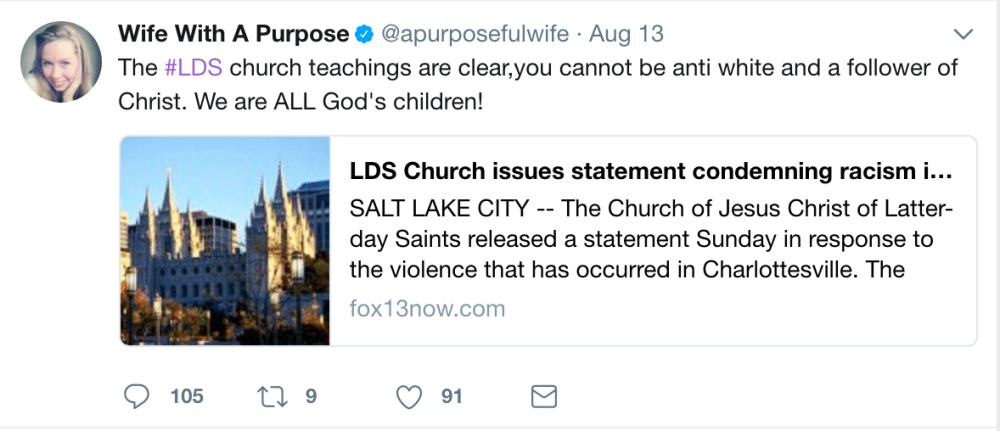
Once that event caused a national backlash, the LDS Church released a timid statement that “people of any faith, or of no faith at all, should be troubled by the increase of intolerance in both words and actions that we see everywhere.” It mentioned a recent prophet’s denouncement of racism, but the entire statement was quite general toward “intolerance and hatred.” And just like how white nationalists in America rejoiced in the lack of an explicit denial from Donald Trump, Mormon proponents of the alt-right on Twitter happily noted that the Church did not explicitly condemn them:

Screen Shot 2017-08-15 at 3.06.24 PM

Mormons noticed. Many petitioned the Church to be more direct in their denouncement of white supremacy. Eventually, the Church updated its announcement on Tuesday with the following direct rebuttal:

It has been called to our attention that there are some among the various pro-white and white supremacy communities who assert that the Church is neutral toward or in support of their views. Nothing could be further from the truth. In the New Testament, Jesus said, “Thou shalt love the Lord thy God with all thy heart, and with all thy soul, and with all thy mind. This is the first and great commandment. And the second is like unto it, Thou shalt love thy neighbour as thyself” (Matthew 22:37-39). The Book of Mormon teaches “all are alike unto God” (2 Nephi 26:33).

White supremacist attitudes are morally wrong and sinful, and we condemn them. Church members who promote or pursue a “white culture” or white supremacy agenda are not in harmony with the teachings of the Church.

This is perhaps the most direct condemnation of white supremacy the Church has ever issued. (Much to some people’s chagrin.)

But perhaps just as important, it was a direct attack on so-called “white culture.” This is one of the rare instances where the Church went beyond what was expected. It even placed “white culture” in scare quotes, implying that such cultural categories are artificial constructions and “not in harmony” with LDS teachings. As depressing as such a realization may seem, this stance is quite progressive when compared to most official positions. And since it was presented by the Newsroom–in many ways, whether good or not, the most authoritative organ of the modern Church–it carries substantial power.

Whether consciously or not, this statement could open the door to new possibilities. Those hoping to reform LDS culture in an attempt to rid it of troubling remnants of “white culture” now have convincing tools with which to do so. Because, as scholars have often pointed out, elements of whiteness are everywhere in Mormon culture: our artistic depictions of divine beings (with a caucasian Godhead), our methods of cultural performance (like dress and grooming standards), or even our religious rhetoric (and its devotion to “whiteness”). These are outward manifestations of systematic cultural institutions. And, thanks to this new statement, they are not as stable today as they were yesterday.

The Church may yet come to the point of directly refuting its racist past and addressing its racial present.