The Pedigree of the Enlightenment

I already blogged a little about Nancy Isenberg’s excellent White Trash, and I have a semi-substantive review of it scheduled for Wednesday, but one specific point has been sticking with me since reading the book. It actually dovetails with another excellent book I read this summer, Alison Bashford and Joyce Chaplin’s The New Worlds of Thomas Robert Malthus (Princeton UP, 2016), which looks at Malthus’s famous Essay on the Principle of Population (1798) and examines how the text had a global context and was primarily addressing questions posed by the colonization of the new world. (In brief: while Malthus’s controversial book did indeed draw from and speak to the debates over poor people in Britain, it was also focused on colonization efforts throughout the Pacific and Atlantic worlds, and had surprising implications for inter-indigenous encounters and ethics. It’s a model of how global intellectual history can and should be written.) Anyway, both books interwove an important lesson: many of the individuals now identified with the enlightenment were very interested in sex. And not just sex, but the participants, relatedness, and remnants of sexual relationships.

To be blunt, enlightenment thinkers were concerned with who bred with who, how often that breeding occurred, and what happened with the new breed of children. And “breeding” was a common and potent way of describing it, because they believed human populations could be identified, analyzed, and controlled just like animals. (And both these books demonstrate that the American continent offered a new canvas on which to draw new hypotheses.) In a way this shouldn’t be surprising since the enlightenment has long been cast as an attempt to naturalize and mechanize modes of knowledge, dissecting what was previously sacred and other-worldly. But it is still sobering to see the legacy of these intellectual developments: a cold calculus to control human society. It can never be too frequently reminded that these “liberal” and “progressive” thinkers also gave birth to scientific theories of, say, racial segregation, let alone racism itself. And in Isenberg’s book, one can see how southern thinkers built on these ideas to conceive of a perpetual poor class beyond the reach of redemption.

This mixed legacy is certainly part of the enlightenment’s paradoxical role in the birth of modernity.

(Side note: I’m really excited for Caroline Winterer’s forthcoming book on the American enlightenment. Given her past work, it should be fantastic.)
The Cyclical Nature of Mormon Persecution

I’ve been slowly making my way through Dan Vogel’s excellent 8-volume(!) annotated History of Joseph Smith and The Church of Jesus Christ of Latter-day Saints (Smith-Pettit, 2015). This is an excellent resource for scholars of early Mormon history, as it helps peel back the layers of one of the most problematic yet significant sources in the LDS tradition. It is a good reminder that we need to consider the context in which historical sources were first created. One particular example stood out to me this morning. 

The winter of 1844-1845 was a tough time for Mormons in Nauvoo. A year previous they were calculating a way to elect Joseph Smith president as a last-ditch effort to redeem America, only to see their prophet killed in what they believed to be a state-sponsored conspiracy. They therefor lost faith in the American government. Ironically, it was at that time that those who were working on the Church’s manuscript history, which had been in progress since 1839, was trying to cover the Saints’ expulsion from Missouri. That is, they were forced to once again deal with the narrative of being kicked out of one state even as they were preparing to be kicked out of yet another. When Willard Richards penned this preface to the 1839 portion of the record, he probably felt it just as pertinent for the dawn of 1845:

Tuesday, January 1st, 1839, dawned upon us as prisoners of hope, but not as sons of liberty. O Columbia! Columbia! How art thou fallen! “The land of the free, the home of the brave.” “The asylum of the oppressed.”–oppressing thy noblest sons, in a loathsome dungeon, without any provocation, only to have claimed to worship the God of their fathers, according to his own word and the dictates of their own conscience. (3:229)

Vogel dates this editorial insertion to February/March 1845. Richards probably believed life was repeating itself. (Though in both cases, the “without any provocation” might be a bit biased…) It struck me how penning this history must have worked to re-live it at a moment where the pain and frustration was only compounded. It probably intensified their animosity, and framed future experience. 

As True Detective put it, time is a flat circle

Two Important Twitter Threads on Trump’s Politics and Danger

I don’t know if we’ve ever seen a presidential campaign unravel like Donald Trump’s has in the last couple days. One of the downsides of the #TwitterAge is that there is smart commentary coming fast and furiously (also dumb commentary, but ignore that), and it is hard to keep track of it. Here are two threads from the past 24 hours that I thought were especially incisive and, in the second case, terrifying.

The first, a thread from journalist Judd Legum on the politics of endorsing and unendorsing Trump, and why many GOP politicians are now stuck in a corner of their own making.

The second is a much more terrifying thread, this time from John Noonan, who did national security for both Jeb Bush and Mitt Romney. This is one of the many examples of why opposing Trump is more than just a political issue–it’s an issue of national and global safety.

Analyzing White Trash in the Age of Trump

I recently breezed through Nancy Isenberg’s recent White Trash: The 400-Year Untold History of Class in America (Viking Press), which is both imminently readable and immensely smart. It is also incredibly relevant. Her argument is simple: the image of a poor, lazy, and immobile class has long been a potent problem in American culture, a constant reminder that “the poor are always with us” and that class hierarchy is always present. This base of people–or at least the fear of them–has been a motivating factor since the colonization period through the present. As actors themselves, the “white trash” have both attempted, at various times and to varying degrees, to reclaim their identity and proclaim their heritage. And at certain points, they can be mobilized as a political force. 

And Trump’s core message is nothing if not an appeal to the anxieties and desires of poor white people. Unlike Romney, he’s not explicitly drawing from rich Wall Street executives–as seen by Michael Bloomberg speaking at the DNC this year–nor is he pledged to mainstream conservative pundits, as seen by Ross Douthat’s disillusionment. Rather, he stokes the fears of those who have been cast as “losers” their whole lives, those who feel they have been disenfranchised, ignored, and dismissed. Trump promised them he’ll restore their honor and redeem their heritage. A common adage of his most devout followers is that Trump “says what he thinks,” which is of course rubbish–Ted Cruz said what he thinks–but they love to hear someone express the same concerns, judgments, and ideas that has been mostly banished from polite society. 

The obvious irony, of course, is that Trump was born with a golden spoon and has made a career of taking advantage of the poor in attempt to cater for the rich. But this quixotic bedfellows relationship only proves both the malleability and potency of this cultural legacy. 

By the way, I hope that the moniker “Age of Trump” won’t last that long. But even if Trump loses this Fall–far from assured, sadly–Trumpism will, just like the poor, always be with us. 

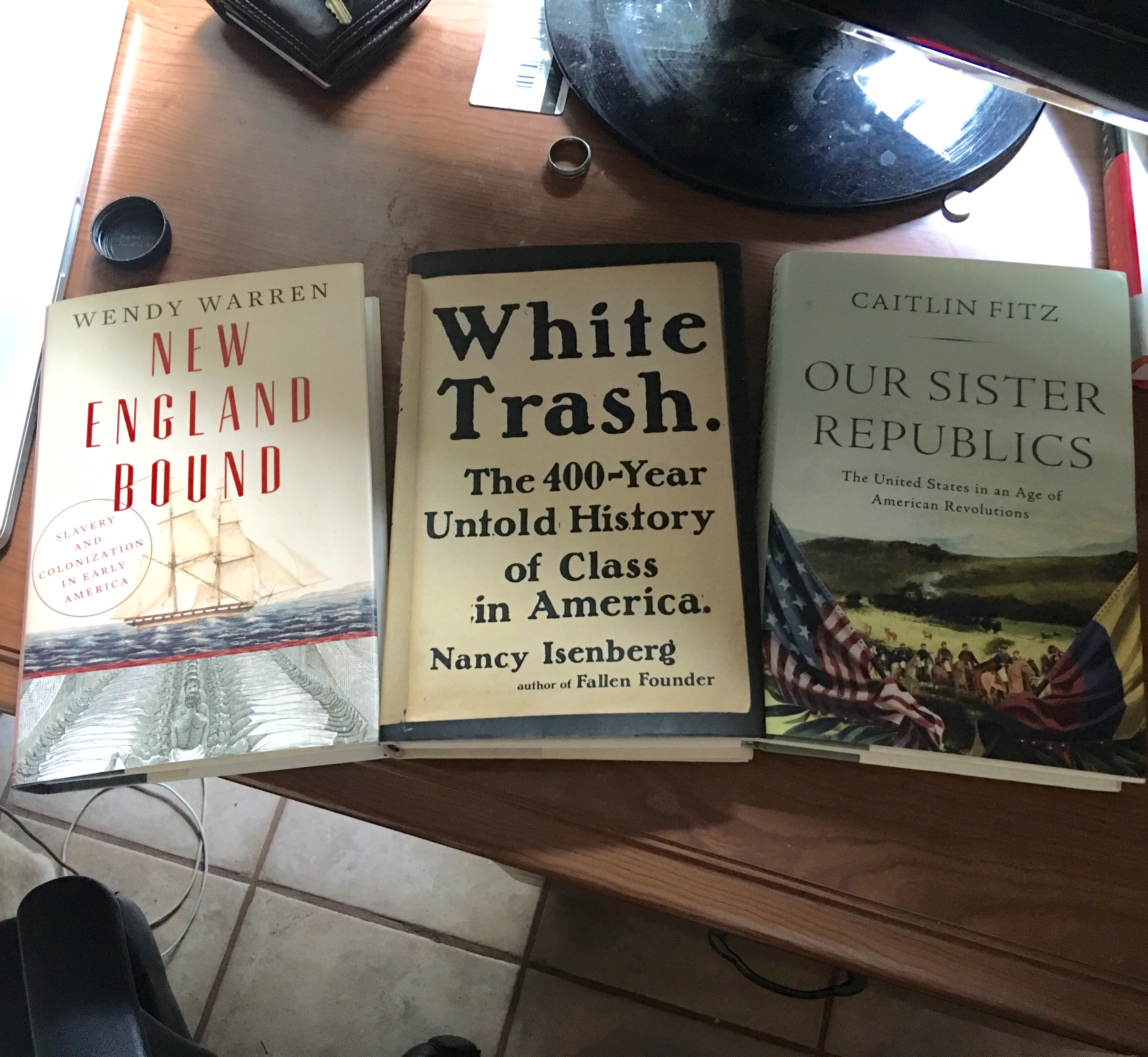
New Book Arrivals, July 2016

One of the best parts of returning from a trip is finding books that you had pre-ordered and promptly forgotten. Nancy Isenberg has become even more recently with her sharp (if somewhat overstated) critiques of the Hamilton musical, but she’s always been one of the wisest commentators on American political and social history; I’m quite excited to dig into her history of “white trash.” 


I had the privilege of meeting Caitlin Fitz at a Kinder colloquium last year, where we workshopped the final chapter of her new book. It was very good, and her recent Journal of American History article on nationalism and the War of 1812 was also wonderful. I expect nothing less from this book, and it’s especially relevant to me given its relation to my manuscript on early American nationalism. This is a great time to be working on the Age of Revolutions, which I’ve blogged about a couple times this year. 

I don’t know much about Wendy Warren and her new book on colonial New England’s connection to slavery, but I’m sure it will help further the recent drive to demonstrate how deeply enmeshed slavery was in early America. I’m sure Bill O’Reilly will love it. 

I’m especially glad to see all three books published by trade presses. A good sign, methinks.